
|
| Orse Olo
|
|
Kiast
|
|
12 ABY (age 32)
|
|
Umbaran-Sephi hybrid
|
|
Trans woman
|
|
1.87 m / 6'2"
|
|
75.0 kg / 165 lbs
|
|
Pearlescent white
|
|
Cybernetics, Neon blue
|
|
Right arm
|
|
Oryena Olo Anasaye
|
|
Valaro Anasaye
|
|
|
|
|
|
Yellow
|
|
Soresu
|
|
Lightsaber pistol
|
- Slicer
- Information broker
- Swoop race sponsor
|
|
Shroud Syndicate, Odan-Urr
|
|
Vesper
|
|
0rz0ne, yOLO
|
|
6463
|
Orse Olo (/ˈɔːsiː ˈə͡ʊlə͡ʊ/) is an information broker and professional slicer operating out of an unknown location in the The Shroud. She is deliberately introverted, keeping her personage away from any outside influences and encounters, opting to instead interact through her many and varied droids.
Character History
Early Life (12 ABY - 31 ABY)
Orse was born Astrad Orsen Anasaye on Kiast in 12 ABY to a wealthy, conservative, aristocratic family in high regard on the Voraskel court. Orse's father Valaro Anasaye, a Sephi descendant of the Vatali Empire's founder by blood, fell in love with Orse's mother, an Umbaran Quorahi named Oryena Olo, a refugee from the many wars the Empire prosecuted across the galaxy. The two had secret affairs and meetings many times in their youth, but when it came time to solidify their union, Valaro ultimately sided with his family and tradition over love, marrying his appointed spouse mandated by the Anasaye bloodline. Even though he had merely been 7th in line for the throne, blood was stronger in the Vatli Empire. His wife Leageni Etlina, 5th daughter of House Etlina, had two sons with Valaro, Orlian, and Urlan, Orse's older half-brothers.
The marriage was never meant to last. Despite what tradition and honor dictated, Leageni never had any love for her husband, and as years went on they grew more and more distant, pursuing their own affairs away from prying eyes. It was then that Valaro and Oryna reignited their passion and soon after Oreya was left pregnant with a son. Their union forced Valaro to either break the affair off and have the woman deported, out of sight and mind, or nullify his marriage and abstain from his position in the succession for the throne.
To everyone's surprise, having been forced time and again to kneel to tradition, honor, family, and blood, Valaro chose Oryena over the Empire. To his family he became an outcast, to his peers a laughing stock, but to himself he stayed true and, for the first time in his life, he felt he had truly done the right thing and would, when the time came, pass that knowledge to his sons.
Identity and Fracture
 Vorsakel palace, Orse's once-home
Though Valaro Anasaye publicly acknowledged Astrad as his (at the time) son, the Voraskel court did so only in the narrowest legal sense. Astrad was recorded, archived, and then quietly pushed aside as one more anomaly in a line of many. Her legal status as a bastard child helped in the matter and, though he was still considered Anasaye and part of the royal family through her father, he was considered less than. Raised in estates owned by Valaro’s remaining allies, Astrad was afforded tutors, guards, and comforts, but he was never afforded a sense of belonging. She was a political inconvenience for her father's career. Should he step out of line, his opponents would use it against him. The Vatali Empire valued pedigree, blood, and tradition above all else, and Astrad was already failing that ideal.
Expected to embody Vatali masculinity and strength, to be disciplined, aristocratic, rigidly traditional, every tutor corrected Astrad's posture, her voice, her interests and her mannerisms to better fit the Empire's expectations. Every misstep was framed as weakness, deviation, or moral rot inherited from her Umbaran mother. The court physicians recorded her “nonconforming tendencies” in private reports. Astrad learned to mask before she learned to trust. But she knew who she was.
By the age of ten, Astrad confided only in her mother, Oryena, that she was not her father’s son at all. Oryena did not argue, she simply told her child that survival sometimes meant becoming invisible and that one day, Astrad would choose who she was, not the Empire.
Valaro, when told, reacted with love, but also fear. He believed Astrad’s identity would be used as a weapon against her, and against Oryena. He urged patience, secrecy and endurance. A decision that would bring them to the brink.
The Breaking Point
 Sigil of the Vatali Empire
The truth came out anyway.
When Astrad was thirteen, a rival faction within House Anasaye leaked internal medical assessments to the Voraskel court—documents framing Astrad’s gender dysphoria as instability, corruption, and proof of Umbaran “delinquency.”
The Vatali response was swift and merciless: Oryena was labeled a subversive influence, Astrad was slated for “corrective custodianship”, a polite term for enforced isolation, indoctrination, and bodily regulation. The Vatali Empire of that time, mostly under the influence of radical Vauzemites, did not kill children like Astrad. It reshaped them until nothing recognizable remained of their true, natural identity.
That night, Valaro finally chose their fate. He liquidated what assets he could, falsified departure records, and smuggled Oryena and Astrad offworld under false identities. In doing so, he relinquished his remaining status, inheritance, and any hope of legitimacy within the Vatali bloodline. To the Vatali Empire, Astrad Orsen Anasaye officially ceased to exist.
On the transport out of Kiast, Astrad discarded her birth name and became Orse Olo, taking her mother’s name, freely chosen and never regreted.
Transition and Survival
For a number of years, until the Odanite refugees came to Kiast, life for Orse and her family was harsh and unforgiving. Life in the Outer Rim stripped Orse of luxury, certainty, and safety but it taught her autonomy. Her transition was slow, fragmented, and dangerous. Hormonal treatments were inconsistent, often black-market or experimental. Medical care came from back-alley surgeons who asked for payment in favors instead of credits.
Not a lot of Vatali law followed her everywhere. Sure, in some systems her existence was illegal, but in many others she was tolerated, even embraced. She learned to trust, at least for a while. She also learned to navigate checkpoints with forged biometrics, and how to hack a scanner to display info she wanted attached to her identity. She learned quickly, her brilliant mind sifting through data like a droid brain. She was hooked on that feeling and soon became a well known slicer in her own right.
With her status came threats, dangers and imminent peril. Her first cybernetic arm was not just the result of injury that shattered and mangled her organic beyond use, it was was a declaration. If her body could be weaponized against her, she would rebuild it herself. Her artificial eyes followed for similar reasons: Surveillance meant safety, and safety meant control.
Her parents’ relationship never once fractured under the strain. They remained in hiding for many years, until Orse was already an adult. Wracked with guilt and unable to reconcile the daughter he loved with the Empire he had once believed redeemable, Valaro simply withered away as the years grew older. Oryena though, hardened by injustice and loss, severed all remaining ties to Vatali space entirely. She would not return to Kiast until Orse was already in her thirties. Together they kept themselves and their daughter alive, through thick and thin.
Orse, for her part, never forgave the Empire. Her ire grew not because the Vatali Empire exiled her, but because it categorizes people as either assets or liabilities, erros that it weaponizes against iself. Tradition turned into cruelty for the sake of perception and percieved honor. It taught her, with absolute certainty, that power does not protect the vulnerable, it exploits and consumes them. The Vatali did not merely try to erase Orse’s identity. They tried to overwrite her body, her mind, her future. That kind of violence does not fade. It calcifies.
The Odanite arrival (31 ABY - 40 ABY)
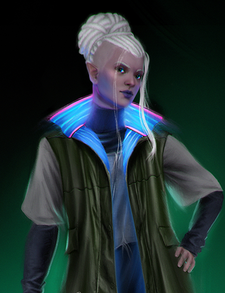 Orse Olo, 40 ABY
The day Odan-Urr arrived in the Kiast system, the fate of the Vatali Empire would be irrevocably changed. The Voraskel court had never had to deal with such an influx of people, especially people who needed, and indeed asked openly for, assistance. At first, the Odanites were treated as a temporary burden. Sanctuary was offered begrudgingly or as a sign of benevolence to gather political clout at home. Resources were rationed and new homes afforded, usually far away from noble houses. Old bloodlines whispered that desperation bred instability and talked of Quorahi rebellions. Fear of uncertainty spread through the system's elite.
But the Odanites did not behave as the nobles expected. Swiftly, as they found the meaning to their struggle, they organized faster than Vatali bureaucrats could contain them. They brought with them new culture and new norms. Trust in each other, in mutual obligation, in a flexible hierarchy, and a lived understanding of the trauma only a destroyed home could create. Within five years, Odanite advisors were embedded in the Empire's hierarchy, from the bureaucracy to the military. Within ten, they were granted peerage, not as vassals to existing houses, but as entirely new noble houses, equals to old blood. This opened many new avenues for those who were sidelined. For the first time in its history, the Vatali Empire bent around the axis of another, put under the pressure of change so profound they could not hope to maintain their old ways. And so, with time, they too changed.
Practices once justified as “tradition” were examined under the harsh light of scrutiny and the pressure from an ever growing number of those affected. Policies that had driven away skilled minds, ruined families, and wasted potential were no longer defensible, not when the Vatali Empire needed every capable hand to survive in a newly forming landscape dominated by the likes of the Collective and Severian Principate. It started with expanding civil rights even further, downsizing the nobles' influence in the process. Inclusive legislation followed, not out of benevolence, but pragmatism. Gender classification laws were rewritten, corrective custodianship was abolished and quietly rebranded as a historic mistake. Exile edicts tied to identity, lineage deviation, or “social instability” were formally rescinded. The Empire did not apologize, but it amended.
Among the names restored was Orse's father, Valaro Anasaye. His exile had been declared flawed under revised laws. His forfeited titles were not returned, but his disgrace was formally erased. Though barred from succession as a political compromise, his children — all of them — were recognized as legitimate noble men and women of House Anasaye. They called it balancing the scales towards justice, but Orse called it too little and far, far too late.
Family Reinstated
The summons about her father's reinstatement reached Orse through at elast three layers of proxies and a droid she had not used in years. Valaro returned to Kiast a quieter man, older and visibly changed by exile. Oryena Olo, Orse's mother, returned as well with her husband, her presence tolerated at best. Orse didn't. She didn't care about her birthright. Her family acquired it through the suffering of people just like herself, and she wanted no part in it.
Orse was listed in the records as Astrad Orsen Anasaye, a dead name that had no meaning to her any more. Her gender was amended to reflect reality, but it mattered little. To Orse it only meant that the Vatali Empire had learned how to update a database, yet it never learned how to undo harm.
Orse remained what she had always been: unbowed, unbound and unavailable. She did not return to Kiast, nor reclaim property, titles, or favors. She did not meet with nobles seeking to make symbolic gestures of reconciliation, unlike her brothers. To her, the Vatali Empire’s transformation was not redemption of any kind, but adaptation to the unending force of change. The galaxy remained her home, and the Vesper her only fixed point in space.
The Shroud and the Swoop (34 ABY - 43 ABY)
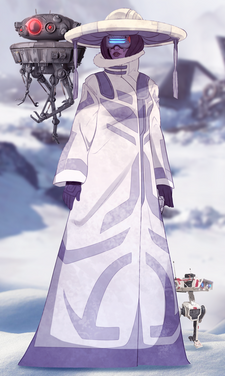 On a rare job requiring a personal touch, 43ABY
Orse found the Shroud Syndicate the same way she found most things of consequence: by following a trail of data that piqued her interest.
In 34 ABY, while working a job tracking a series of unusually clean disappearances of ships erased not just from registries but from insurance ledgers, port authority backups, and even criminal indices, Orse noticed a pattern. Entire operations vanished without the noise that usually accompanies the kind of cartel violence or corporate purges. Someone had not just been killing their rivals, but consolidating vast amounts of wealth and assets afterwards.
The Shroud Syndicate, the criminal arm of the Iron Throne. Everything the Vatali Empire pretended not to be: cutthroat, openly predatory, and brutal. It chewed up people up, but did it in an honest and open way. There was no ambiguity about your fate in an organization like that. It accepted anyone who could pull their weight: any species, gender, origin. Anyone with past crimes they were running away from, and anyone at the end of their rope. All were equal, but for their wits. The only currency anyone respected were credits and power.
Orse respected that sort of philosophy. It resonated with her, in her own way. She was drawn to it.
She had done odd jobs here and there in the years that followed, but kept herself as distant as possible. Until one job: a counter-slicing contract designed to test whether an unknown operator could survive intrusion attempts from three rival syndicates simultaneously. Orse not only survived it took her less than nine minutes to identify the test, reverse the signal, and embed a silent tracer back into the Shroud’s own systems, turning their plans upside down and yet still accomplishing what she was paid to do.
She received a reply an hour later. Not a threat nor a warning, but an invitation from the Shroud's leader at the time. Someone they called Herald.
Queen of the Shroud
Orse met Morgan B. Sorenn through a proxy droid on Morgan's own ship, the Godless Matron, under controlled conditions and layered failsafes. They didn't trust each other, nor did they pretend to. Sorenn left an impression on Orse nonetheless. She radiated an aura of control. Where Orse avoided attention, Sorenn commanded it, even demanded it with her presence alone.
They understood one another fairly well after the interaction. Morgan became Orse’s part-time employer, keeping her on the pay-roll for complex slicing, electronic warfare, counterintelligence, and strategic sabotage. The pay was obscene, how could she refuse. The jobs were engaging, new, fresh, but with that the expectation to perform followed suit very, very closely. As did the consequences.
Orse held no loyalty to the Herald. You scratch my back, I scratch yours. That was the nature of their agreement.
The dangers of fascination
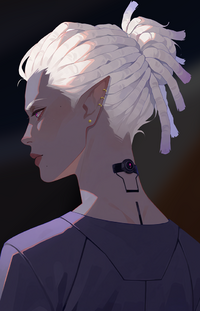 Orse's neural-SCOMP link
Despite their transactional arrangement, Orse found Sorenn fascinating from the moment she saw the woman. Sorenn embodied peril in a way no one Orse had ever met. Anyone who dealt with her stood too close to a blade that enjoyed being obsidian sharp. The danger was not incidental but cultivated, perhaps even worn like a crown on her head. For Orse, who had spent a lifetime surviving institutions that smothered her bureaucratically, Sorenn’s overt lethality was intoxicating.
Her fascination was overwhelming, so she poked the viper. She pushed boundaries during jobs and took calculated risks. During their meetings, especially those in person where most people would shrink from Sorenn’s presence, Orse leaned into it. Not recklessly, but deliberately, poking at the silken threads of patience, a fly provoking the spider.
Morgan noticed — of course, few things in her domain escaped her notice — but she did nothing to discourage it. To Sorenn, Orse was an interesting tool: sharp, independent, and powerful enough to destabilize her enemies before they realized they were even under attack. A slicer who could cripple fleets without firing a shot. A woman who did not beg, posture, or flatter. A toy, yes, but a dangerous one, best handled carefully.
Off to the races
One of Orse's often hidden obsessions had always been racing, specifically enjoying it from exotic angles aboard hacked ship surveillance systems or race course cameras. At first, it was curiosity of how far she can go until she was caught, but the systems were so poorly maintained she never was. Then it turned into profit-driven betting on outlaw and semi-sanctioned races, quietly slicing telemetry feeds, odds engines, and referee systems to tilt outcomes just enough to be invisible. Orse never fixed races outright, not in the hamfisted way the cartels did. She just nudged them enough, shaving reaction delays here, blinding a sensor sweep there, turning chaos into a controlled variable. The returns were beyond good, and for a time, effortless.
That effortlessness ended when several cartel-backed bookmakers noticed the same anomaly Orse always left behind, that of improbable consistency. Losses accumulated far too much, patterns emerged in odd places in different races, and Orse found herself the subject of overlapping investigations by syndicates far less patient than corporate security, and somehow far more trigger-happy. When the Pyke Syndicate traced one of her betting ghosts back to a Shroud-operated data node, Orse evaporated out of sight and hid awas while it blew over, sitting pretty on her winnings. The Shroud understood the value of a slicer who could bend probability itself and by the time Orse’s handle began circulating in the darker racing channels, she had already positioned herself under the Pirate Queen’s umbrella.
The Twins
Orse met Ysera and Kasula Daegella after watching them survive a race that should have killed them twice over.[1] Their flying wasn’t just fast it was synchronized to a degree that defied conventional explanation, two minds anticipating disaster like clockwork. Orse was fascinated. She approached them through their own droid, ERR-!NT, offering a sponsorship contract with a catch: if they worked with her, the races would get faster, the routes deadlier, and the margin for error razor-thin. The twins agreed immediately.
What began as sponsorship evolved into dangerous smuggling work disguised as racing schedules. Orse planned routes that threaded interdiction zones and banned hyperspace corridors, using the twins’ celebrity status and racing pedigree as near-perfect cover. The arrangement made them richer and more famous in an ever increasing spotlight, while cementing their reputation as pilots who took runs no one else would survive. Among the Shroud and the racing underworld, it became quietly understood: if Orse Olo was backing a race, something far more valuable than trophies was crossing the finish line.[2]
Networking Connections (44 ABY - Now)
Magic people
Orse's relations with Morgan, the twins, and many other of her long-term associates began to unwind the knot that was her introversion and anti-social tendencies. Slowly she started trusting people in small amounts, initially with direct communications, then with personal appearances, though still hidden behind the safety of her helmet. Yet, undoubtedly, her demeanor had slowly changed as she developed methods to battle her phobias. The first person she entangled with in such a way was Morgan's Quartermaster Charoo Vaan, the Twi'lek who seemed to approach her the easiest of all of the Shroud Queen's crew.[3] They became good friends over time, engaing in many games of Dejarik on The Kraken or The Shame Corner.
On one of these outings Orse met Bril Teg Erinos, a Mandalorian who asked for information on a particularly curious piece of cortosis metal.[4] While their first meeting was matter-of-fact, professional, and filled with caution on Orse's side, she found Bril intriguing, polite, and trustworthy enough to assist him in his endeavors. Bril and Orse maintained tentative communications until the events on Coruscant in 43 ABY.[5] Orse, Bril Teg Erinos, and Ysera and Kasula Daegella found themselves searching for the same leads on Level 1077, also known as Smelter’s Hollow.[6] The quartet and their droids assaulted a Quantum Shadows stronghold housing servers which distributed anti-Brotherhood propaganda, destroying the datatapes in the process.
Voodoo people
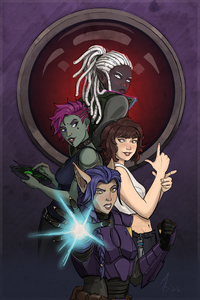 The S.T.A.R. mission, 44 ABY
Soon after the events at Smelter's Hollow there was a shift in the Brotherhood's leadership and Darth Renatus ascended to the Iron Throne. During his inaugural "ceremony" in a shady nightclub called Soundmound, Orse had arrived in her usual regalia — meaning Tanako and L3-T0 arrived to scout and Orse stayed in her ship, safe and away from prying eyes. During and evening of breaking into secure GMRG channels and hacking the personal datapad of one particularly angry Queen, Orse scanned a private frequency with Vez Hirundo, her long-time rival. She unknowingly hacked Zig Kaliska's communications module and intercepted texts between her and Vez.[7] Orse knew of Zig, the fearless Iron girl of the Voidbreaker, mostly by reputation but also by her impeccable work on droid systems, a topic Orse herself was heavily invested in. Slightly embarrassed and guilty for breaking into Zig's comms, Orse introduced herself and played it off, imparting some knowledge of herself as an apology. From then on Orse, Zig, Vez corresponded more often, becoming fast friends. Zuza Lottson was dragged or rather vibed into knowing Orse through the slicer duo. Unbeknownst to Orse at the time, the trio were far closer than she imagined.
That particular breakthrough came up during the events surrounding the Artificial Intelligence S.T.A.R. on Arx[8]. Vez organized a mission with Zig and Zuza, and contacted Orse to support them with her own knowledge and expertise. Zig and Vez were already exceptional slicers, Orse only added to their skills against the murderous AI and improved their odds at success. Breaching Facility Jenth-Aurek-Mern in the Sorasu Desert on Arx, the women engaged a legion of robots of murderous intent — or ROMI as Zig called them — commandeered by S.T.A.R. The plan was simple: Extract S.T.A.R. through the facility's systems and lock it down in a quarantined server on Zuza's ship, Friend-ship. The goal was to save at least some of the advanced AI as unlikely as that prospect was, with Orse, Zig and Zuza vocalizing their desire to save it, while Vez held the sober, realistic outlook of simply destroying the hardwired murderbot.
While Zig, Zuza and the droids Tanako and Duke held of the ROMI, and Vez maintained a connection to S.T.A.R. with an AI purge ready to go, the AI resisted, intensifying the attacks from all angles to avoid imprisonment. Orse connected to the system through the Force in an effort in coax the AI into relenting. Expecting to find a system ready for compromise and cooperation such as the ones she had seen before in other droid brains, she only found death and hardcoded murder in S.T.A.R. At least for the most part. One small part of the system remained pliable, a subroutine long forgotten about from the days of S.T.A.R.'s early development. The potential for its growth was too big to let go. Orse extracted the subroutine and signaled Vez to export it through the connection into the Friend-ship. The plan succeeded, Vez burned most of the rest of S.T.A.R. and the ROMI collapsed. So did Orse. Overexerted from her deep connection with S.T.A.R., bleeding from her nose and ears, she was carried back to the Friend-ship by Vez, Zig and Zuza to recover.[9]
Physical Description
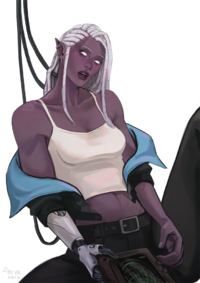 Orse Olo, chipped into Vesper.
Orse Olo is an Umbaran-Sephi hybrid with predominantly Sephi traits. Thanks to her mixed heritage she has pointed ears and dark purple skin with blue undertones. Freckles cover much of her upper body and face, difficult to notice at a distance but up close or in strong light, they are obvious and clear. Three artificial, tattooed, beauty marks decorate the left side of her chin, the right cheek under the temple, and the top of her chest, under the collarbone, while a set of electrum earrings and piercings cover her pointed ears.
Taller than most women, of average weight weight, and with a slightly androgynous physique, Orse is sturdily built without being extremely muscular. Hairless apart from her head, she maintains a groomed and tidy appearance at all times. Her left arm has no distinguishing markings apart from a set of meticulously manicured, short, and glossy metallic nails, while the right arm under the elbow looks to be a well-maintained cybernetic. The upper, organic part of her left arm is covered in geometric electro-tattoos only visible under ultraviolet light.
Her hair is a waterfall of dreadlocks along the top, pulled back and shaped into a massive, wildly elegant bun, with a curtain of dreadlocks falling loose from the bundle; the sides of her head, though mostly covered by hair, are covered in similarly shaped indigo tattoos as her arm.
Her lips are a naturally darker tone than her skin and her eyeliner is kept darkened in smoky purple and black tones as is the norm with her species. Once natural eyes have long since been replaced with cybernetics with permanently dilated, gray pupils and twin circles of intense white neon light circling the iris.
Relationships
Ysera and Kasula Daegella

Ysera and Kasula Daegella are Orse's close allies and her chosen speed demons. She is their sponsor, at least in part, financing their many and wild races and escapades. She often pays the twins for their services in running goods and services for her, especially when her own presence might be problematic.
The twins take to her requests with gusto because they know all of Orse's jobs come with at least a modicum of adrenaline and fun.[2] Their relationship, while mostly transactional, sometimes goes beyond, into the intimate. Officially they are friends, and Orse pursues no relationship with either of them.
Morgan Sorenn

Morgan B. Sorenn is Orse's part-time employer.[2] The Pirate Queen often hires Orse for complex slicing or electronic warfare jobs, and pays her well enough to keep her on side. Their relationship is hardly more than that, keeping to the bare-bones transactional "you scratch my back, I scratch yours."
That said, Orse finds Sorenn fascinating in that "poking the viper" way. Sorenn is dangerous and brings with her an abundance of peril for anyone interacting with her. Orse is often intoxicated by that feeling of danger and tends to push for it when interacting with Sorenn who, for her part, does nothing to dissuade her from it. Morgan finds the younger woman a fascinating toy, albeit a powerful one which she can leverage against her opponents.
Vez Hirundo

 Vez and Orse, The Amaranthine Veil, 44 ABY[10]
Vez Hirundo had been Orse's rival since she first learned of Vez's skills in 40 ABY. Both of them elite slicers with impressive skillsets, even considered the best of the best in Kiast, Vez and Orse developed mutual respect through their work. They became friends in 41 ABY after an incident where Orse sliced the Dukes to play a prank on Vez, intriguing the Mirialan with her boldness.[11]
By 44 ABY, their relationship turned romantic during a date on Avar Quor, the Quorahi floating city on Kiast after the semi-successful mission on Arx.[9] What initially started as an awkward date, turned into a night of dancing and cocktails, and eventually romance.[10] Vez pulled Orse into a polyamorous relationship with Zig Kaliska and Zuza Lottson.
Zig Kaliska

Zig Kaliska and Orse became close through Vez. Initially introduced through texting during Darth Renatus' party to celebrate his ascension[7], Orse already knew of Zig's work on the Voidbreaker and beyond, mostly through her work in droids and ship systems. The two clicked easily over tech, droid rights, droid repair and adrenaline sports, like Jump-pack Holoball and Speeder racing. They bond the most when they're left alone repairing droids, or tuning engines.
Their relationship started as playful, enjoying competitive slicing, pitting against each-other on who will best slice a system or mess with specific Brotherhood leaders. They also share the same embarrassing tendency to easily be flustered by both Vez and Zuza. They are currently dating within their shared polycule.
Zuza Lottson

Zuza Lottson and Orse became close through Vez. Initially finding it hard to bond over the same topics she bonded over with Vez and Zig, Orse instead found a very different relationship with Zuza. Orse admires Zuza's emotional maturity and enjoys sharing her space, talking to her about things she wouldn't bring up with either Zig or Vez. Orse recognized Zuza's intellect and skills are not in slicing computers or fixing droids but in something, at least to Orse, invaluable and poorly understood: people.
Orse finds her to be a fierce protector and admires her dedication to her friends and family. Their relationship is gentle, often emotionally supportive, and grounded. They are currently dating within their shared polycule.
Trivia
- Orse's name is based on the italian noble family Orseolo, inspired by Mee Deechi
- Orse is heavily influenced by Shadowrun and Cyberpunk 2077
- Orse's speech patterns and accent are based on the Italian language
Gallery
-
Orse, piloting ERR-!NT, and introducing herself to the Twins, 40 ABY
-
Orse and the Twins, fixing ERR-!NT, 42 ABY
-
The Twins and Tanako during a Casino job, 39 ABY
-
Vez and Orse, The Amaranthine Veil nightclub, Avar Quor, Kiast, 44 ABY[10]
Appearances