A’lora Kituri is a Togruta Force-sensitive born on the planet Shili, whose early understanding of the Force was shaped by cultural tradition and romanticized oral legends of the Jedi — particularly those attributed to Shaak Ti — rather than formal instruction. She was taken under the tutelage of V’yr Vorsa, who guided her early development in the Force and later brought her to New Tython. A’lora would eventually become associated with House Odan-Urr, where she later held a seat on the Council. In the aftermath of New Tython’s destruction and the Inquisitorius’ persecution of Force-sensitives, she stepped away from her Councillor role and adopted the path of a Jedi Wayseeker, remaining affiliated with House Odan-Urr while pursuing a pilgrimage focused on preservation, interpretation, and the future of Jedi teachings.
Character History
Daughter of Shili (4 ABY - 20 ABY)
- "Children, gather 'round the fire, for tonight I shall share with you a story that has been passed down through the generations of our people — a tale of courage and determination, of a Togruta named Jora Malli."
- ―Utukaan the Elder
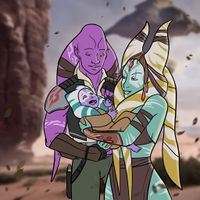 A'lora Kituri, with parents Iss'tass Kituri and Garess Kelr.
A’lora Kituri was born on the planet Shili in 6 ABY, during the early years following the fall of the Galactic Empire. She was raised in a traditional Togruta village located away from the planet’s major population centers, where daily life remained shaped by long-standing custom rather than galactic politics. She was the daughter of Iss’tass Kituri, a huntress and artisan known within the community, and Garess Kelr, an off-worlder who had chosen to settle among the Togruta rather than continue a life of travel. Garess’s experiences beyond Shili brought occasional contact with traders and visitors from other worlds, but his decision to remain planet-side ensured that A’lora’s upbringing remained firmly rooted in village life rather than shaped by the wider galaxy.
Although Shili itself held long-standing importance within the Republic, A’lora’s early childhood was insulated from the concerns of the New Republic’s early consolidation — defined by local custom, family responsibility, and communal continuity. Even in the preceding years, there was never any sustained Imperial presence in the region she grew up, and the village itself neither resisted nor collaborated, existing largely outside the Empire’s immediate concern. For A’lora, the wider galaxy existed as something discussed secondhand, or brought in by travelers, rather than as a constant force shaping her childhood.
Within the village, history was preserved through oral tradition rather than record. Elders passed knowledge through story, ritual, and repetition, ensuring continuity across generations. Among them was Utukaan, a respected storyteller whose role was not to instruct as a teacher, but to shape understanding through narrative. Through him, children were introduced to figures associated with the Jedi — names such as Shaak Ti and Jora Malli — presented not as precise historical accounts, but as legendary guardians whose deeds had been shaped and amplified over time. These accounts were told as heroic tales — embellished, dramatic, and shaped to capture the attention of young listeners.
The Tree on the Hill
- "I have always been here, from the time the old man planted this garden at my roots, to the times when you returned to care for this garden that I call home."
- ―V'yr Vorsa
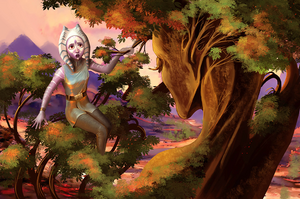 A fateful meeting on Shili, 14 BBY
The garden tended by Utukaan lay beyond the village, centered around an ancient tree that had once been one among many in a larger forest. Over time, the surrounding land had thinned and changed, but the tree remained. A'lora was still a youngling when she learned to tend the garden Utukaan had painstakingly cleared, planted, and maintained around its roots. She assisted the aging Togruta gradually, accompanying him often enough that the work became familiar. She understood the intricacies of tending it, and she enjoyed the time spent there, listening to Utukaan speak while working with her hands.
She was but nine years old when she remained in the garden longer than intended after a solitary day's work. Instead of returning to the village, she rested beneath the tree and fell asleep. When she woke, she found herself lifted from the ground and cradled within a lattice of the tree’s branches. Though startled by the change, she was unharmed.
The presence bound to the tree revealed itself as sentient, capable of speech and awareness, and long-rooted in the garden. When A’lora introduced herself, the being identified itself as V’yr Vorsa. Vorsa spoke openly of the village and its people, including Utukaan and A’lora’s parents — knowledge acquired over time by listening as the elder spoke to the plants and animals while tending the garden. Vorsa asked that her name be kept secret and that it not be shared with Utukaan or with A’lora’s parents. A’lora agreed. She remained in the garden through the night, sheltered among the branches, while Vorsa kept watch over the surrounding area and the wildlife that passed nearby. When morning came, A’lora returned to the village and continued tending the garden as she had before, without speaking of the encounter to anyone else.
Foundations
- "Utukaan said I'd find you here. He's sent you on one of his 'errands,' hasn't he? He's a lazy old fool... but at least he admits it. Deliver these 'things' to your father on your way to indulge the old man. I'm not sure what use he has for them, but he insisted on giving the last smuggler half of our last season's trade for it."
- ―Iss'tass Kituri
 Shili, the Togruta homeworld.
A’lora was a familiar presence within her village, known to the other children and regularly involved in daily activities. She took part in shared chores and group tasks, but she also involved herself readily in small rivalries and informal contests with other children. She was openly competitive, quick to test herself and slow to concede once engaged. While this sharpened her skills and confidence, it also made some of her peers cautious about engaging her directly, preferring games or tasks where competition was less likely to emerge. Over time, this gave A’lora a reputation for intensity rather than ease, shaping how others chose to interact with her.
Among her peers, Kahlee was her closest and most consistent companion. Kahlee’s outgoing nature and ease with others often bridged the gaps A’lora created for herself. Where A’lora was focused and competitive, Kahlee was expressive and social, frequently pulling her into village gatherings, dances, and shared errands she might otherwise have avoided. A’lora did not seek out these moments on her own, but she followed Kahlee readily, and the two were often seen together moving through daily life. Beyond Kahlee, A’lora remained connected to a wider circle of village children, though her relationships within that group were shaped more by proximity and circumstance than by closeness.
A’lora’s relationship with the village elders, particularly Utukaan, was unusually close for someone her age. Utukaan often welcomed her presence during storytelling and quiet tasks, recognizing her attentiveness and willingness to listen. His stories emphasized decisive moments and heroic deeds, and A’lora responded strongly to those elements. She was less interested in reflection than in what characters did, and what followed from those actions. The lessons she absorbed were framed through consequence and outcome rather than restraint, shaping how she evaluated strength and resolve.
Within her family, A’lora’s relationships were equally formative. Iss’tass Kituri set firm expectations, valuing competence, responsibility, and contribution to the village. A’lora respected her mother’s discipline, even when she resisted its limits. Garess Kelr, by contrast, brought glimpses of the wider galaxy home with him. He returned from trading runs with stories, tools, and occasional gifts, and A’lora was familiar with those who worked alongside him, including Niuk, whom she encountered around her father’s ship. Despite this exposure, Garess never took her with him when he left to trade, a boundary reinforced by Iss’tass that kept A’lora rooted in village life even as her curiosity grew.
Years of Transition
- "I remember... long ago, there was a voice on the wind. It was fleeting, like the whispers of the turu-grass. But I was sure of it."
- ―Utukaan the Elder
As A’lora entered her teenage years, the village continued to change gradually around her. New homes were built, trade increased, and outlanders became a more common sight, yet the rhythm of daily life remained familiar. A’lora took on greater responsibility, contributing through fishing, delivery work, and other labor expected of her. She was no longer treated as a child, but as someone reliable and capable, trusted to complete demanding tasks without supervision.
During this time, her relationship with Utukaan shifted. Age and illness had begun to erode his clarity, and A’lora increasingly found herself caring for him rather than listening to his stories. She visited him in the evenings, bringing food, preparing meals, and sitting with him as his thoughts wandered. Though his memory faltered, his attachment to the past remained strong, surfacing in fragments rather than complete narratives. Even as his stories became disjointed, A’lora treated him with the same care he had once shown her, maintaining continuity where his mind no longer could.
It was during one such visit that Utukaan spoke of having heard a voice long ago — something carried on the wind, fleeting but unmistakable. The comment gave A’lora pause, forcing her to recognize that Utukaan had, at some point in the past, truly heard V’yr Vorsa speak. In hindsight, A’lora came to understand that this experience had shaped more than his stories; it explained his enduring attachment to the garden and his insistence on tending it long after the work had become physically difficult. When Utukaan’s recollections drifted close to this truth, A’lora chose discretion, neither confirming nor denying what he struggled to remember.
As winter set in, A’lora’s visits to the garden became more difficult but did not cease. On one such journey, she was overcome by exhaustion and exposure before reaching her destination. She was sheltered by Vorsa within the living trunk of the tree, protected from the cold until conditions allowed her safe return. During this sheltering, A’lora confronted the fear that had taken hold since her conversation with Utukaan. She believed she had failed to keep her promise and worried that, as a result, Vorsa might withdraw from her as well. She asked directly whether Vorsa would stop speaking to her.
Vorsa refused. She spoke more openly of her past, acknowledging that revealing herself to Utukaan in the past had been a lapse born of isolation and loneliness, one she regretted. She reassured A’lora that this did not extend to her. Vorsa made it clear that she would not withdraw, nor did she expect A’lora to forget what had already been shared. The bond between them would continue. No explanation was given beyond this. Vorsa did not speak of her origins, her nature beyond the garden, or her reasons for remaining there. To A’lora, what mattered was the certainty that the connection would not be severed. Before A’lora left, she asked one further question — whether Vorsa would speak to Utukaan again, if he were to come to the garden. Vorsa answered that she would.
With that assurance, A’lora returned to the village, her daily responsibilities resumed unchanged, but her understanding of Utukaan’s long vigilance became part of the same history — one she now carried alone as her life in the village continued.
Garess Kelr
- "Fools. If your father were present, he would have clobbered some sense into you. Holding in a den? That was a fool’s choice, Uluru."
- ―Utukaan the Elder
In the months following the revelation about Utukaan and the voice, and the changes already underway in the village, daily life continued much as it had before. As night fell, villagers gathered near the central fires, following familiar customs of music and dance. A’lora remained at the edge of the gathering until Kahlee took her by the hand and drew her into the circle. A’lora followed reluctantly at first, allowing herself to be pulled along rather than choosing the dance on her own.
The gathering was interrupted when hunters returned from the forest carrying Garess Kelr on a stretcher. He had been injured during an encounter with Akul after the hunting party was forced to take shelter within a den. According to those present, Garess acted to protect others during the ambush. His injuries were severe, and despite the attention of the village’s Duros physician, he could not be saved.
Garess’s death altered both family and village dynamics. Iss’tass Kituri withdrew from active hunting in the aftermath, supported by Utukaan, who argued against immediate retaliation. With winter setting in and Akul activity increasing, the village agreed to wait until spring before attempting to eliminate the den. Travel beyond the perimeter was restricted, watches were increased, and individuals were discouraged from leaving the village alone.
For A’lora, this enforced patience was difficult to accept. Her anger over her father’s death, combined with frustration at the decision to wait, left her restless and confrontational. During this period, she sought out Uluru, one of the hunters involved in the failed expedition. Uluru initially refused her requests for training, citing both the village’s restrictions and Iss’tass’s withdrawal from hunting. A’lora persisted, returning again and again despite being turned away.
Over time, Uluru relented and agreed to train her, filling the gap left by Iss’tass’s absence from the hunt. The training unfolded across many sessions rather than as a single decision. A’lora approached sparring aggressively, pressing every advantage and refusing to concede once engaged. Her competitiveness and unresolved anger made her difficult to train, and their matches were often rough, bordering on reckless. Uluru tolerated this, recognizing both her aptitude and the source of her hostility.
By the time winter began to loosen its hold, A’lora had been training with Uluru for some time. Her skills had sharpened, but so had her impatience. While the village continued to wait for conditions to improve, A’lora’s attention remained fixed beyond the perimeter, already turning toward the Akul den itself.
The Akul Den Expedition
- "Alright, A’lora. I’ll come with you. But we'll only scout the area. We need to understand their patterns, their numbers. We are not engaging them directly. It's too dangerous, especially without a proper plan."
- ―Uluru
With spring returning, the village began preparing to address the Akul den more directly. A’lora had been training with Uluru long enough that their sparring had become routine, and her frustration at waiting had only intensified. The village’s stance remained cautious: no one was to go beyond the perimeter alone, and any action against the den was meant to be organized rather than impulsive. A’lora did not share that same stance. After a sparring session that ended with both of them bloodied, she told Uluru she planned to leave the village that night to scout the den. She presented it as reconnaissance and pressed him to accompany her. Uluru objected and agreed only after setting limits — observation only, no engagement, and a return before the situation could escalate.
A’lora accepted those terms, but she did not treat them as binding. Her purpose was not limited to gathering information. She used the language of scouting to secure Uluru’s help and to avoid drawing attention from the village. The decision was made without approval from the elders or from her mother, and it ran directly against the restrictions the village had established through the winter. They left under cover of darkness and approached the den along routes familiar to hunters. As they drew close, Uluru attempted to halt their advance and turn back, recognizing the risk of pressing farther at night. A’lora continued anyway, driving them nearer than they had agreed. Before they could withdraw, the den’s entrance collapsed, sealing their route out and forcing them into the den’s outer chambers.
Trapped, they searched for another exit while avoiding signs of returning Akul. They located a secondary opening framed by roots and loose soil and attempted to climb free. An Akul returned before they could escape, and the situation became a direct fight. Uluru was nearly pulled into the open, and A’lora intervened at close range to draw the creature away. Her quarterstaff was damaged during the struggle, and she improvised by snapping it into a jagged point and driving it into the Akul’s throat. After the kill, the surrounding pack withdrew rather than continuing the attack.
The Hunters' Return
- "What a warrior you have become. Remember, even the greatest Jedi have their flaws. None of them are perfect, but the Force presses us to move on. It is a constant, ever-changing flow. We will live, we will die. Our passing will be remembered, but those who survive, are stronger for it. Now then! There is one thing I have to attend to. Will you accompany me?"
- ―Utukaan the Elder
A’lora and Uluru returned to the village at dawn. The outcome removed an immediate threat, but it also exposed the truth that the expedition had not been a sanctioned scout and had not remained controlled. For A’lora, it marked the first time she acted beyond the village’s limits through deliberate choice rather than circumstance — pushing past restraint, using Uluru’s support to get there, and learning firsthand what that kind of decision cost.
Only once the village came fully into view did the truth of the night settle between them. Uluru understood then that A’lora had never intended the expedition to end at observation. The way she had pressed forward, the refusal to turn back, the readiness with which she met the Akul — none of it aligned with a simple scout. He did not accuse her. Whatever had driven her out there had already run its course, and naming it would change nothing.
A’lora did not look at him as they crossed the threshold into the village. Her attention fixed instead on the familiar paths, on the low roofs and waking fires, on the place where her mother would already be moving through the early hours of the day. The thought of Iss’tass waiting there — unaware of where A’lora had gone, or how close the night had come to taking her as well — settled more heavily than Uluru’s silence. For the first time since leaving the village, the weight of what she had done was no longer measured against the Akul, but against the life she was returning to.
Uluru slowed, letting a small distance open between them. Whatever words might have passed were no longer his to offer. A’lora’s reckoning, he understood, would not come from him, nor from the hunt, but from standing again before her grieving mother — a woman who had, until now, not had relief of having her daughter returned, safe and sound.
The Elder’s Passing
 A'lora Kituri, Jedi Padawan
- "Come to see an old fool off in his final moments?"
- ―Utukaan the Elder
"No. But I have come to see off an old friend."
―V'yr Vorsa
Several months after the confrontation at the Akul den, Utukaan’s health declined rapidly. Age and illness confined him to his hut, and it became clear to those close to him that he was nearing the end of his life. A’lora and Iss’tass remained frequent presences during this period, attending to his needs and maintaining the quiet routines that had once framed his role as the village’s storyteller.
Utukaan retained a measure of lucidity in brief intervals. During one rare moment of clarity, he asked A’lora to take him to the garden he had tended for much of his life. He spoke of it as unfinished business rather than nostalgia, expressing a desire to feel the soil and see the tree once more. Because he could no longer make the walk, a small sled was arranged to carry him beyond the village perimeter, with A’lora accompanying him.
At the garden, Utukaan was settled beneath the great tree’s branches, resting against its roots. He spoke little, but appeared at ease, attentive to the sounds of the wind and the movement of the canopy above. While A’lora stepped away briefly to fetch water from the nearby stream, Utukaan remained alone beneath the tree.
It was there that Vorsa spoke to him again. Their exchange was brief and private. Vorsa did not reveal herself openly, nor did she speak at length, but acknowledged Utukaan as an old friend and affirmed that his care for the garden had not gone unnoticed. Utukaan, in turn, expressed no surprise. His response suggested that he had long suspected the presence he once heard was real, that he returned time and again, to keep her company all these years. When A’lora returned, she found Utukaan unresponsive, his expression calm. He had passed beneath the tree he had helped nurture, his final moments spent in the place he valued most.
A Life Remembered, A Choice Offered
- "I'm here with Niuk. We're leaving Shili in a few rotations. Your father and I made a promise years ago. If anything ever happened to him, I'd offer you a chance to join us, see the galaxy beyond Shili."
- ―Corbin Navaro
With Utukaan’s passing, the village held a feast in his honor. A bonfire burned at the center while elders traded stories about him and people joined the dancing, eating, and toasts. A’lora stayed near the edge of the celebration at first, watching more than participating. Kahlee joined her there, speaking about Utukaan in the same way the village always had — through remembered moments and his exaggerated retellings of old stories. Some of the stories made Kahlee laugh as she recalled one particular tale in which Utukaan himself managed to tame an Akul. A’lora corrected her assumptions, noting that at least that one “tall tale” had been real, as she had seen the riding harness Utukaan kept as proof, herself.
As the night went on, a villager offered them a drink as part of the toast, and A’lora — unused to it — felt its strength immediately. Kahlee took her hand and pulled her into the circle. A’lora’s participation was imperfect and unpracticed, but she stayed in it, carried along by Kahlee’s insistence and by the fact that this night was for Utukaan. Later, A’lora noticed Uluru searching the crowd. On impulse, she directed Kahlee toward him. Kahlee approached first, and Uluru accepted. From where A’lora watched, it was clear the two of them matched each other more easily than A’lora ever did with the dances — Kahlee bright and confident, Uluru attentive and steady. For A’lora, it was a small relief to see something as uncomplicated and joyful as those two dancing in Utukaan's memory.
The next morning came quietly. A’lora woke with a dull headache and stepped outside for air, finding Kahlee near the ashes of the bonfire. They spoke briefly about the night, about Utukaan, and about how strange it felt to move forward without him. It was there that an off-worlder approached: Corbin Navaro, a human who claimed to have known Garess Kelr from his years beyond Shili. He did not linger on details at first. He offered a simple reason for his presence — Garess had asked him to do this if anything ever happened. Corbin and Niuk were leaving Shili soon, and Corbin was extending Garess’s promise to A’lora: if she ever wanted to see more than the village and its hills, she would be given the chance.
A’lora didn’t answer immediately. Kahlee was wary, but A’lora treated it as real enough to bring to her mother. Iss’tass did not pretend it was easy to hear, but she did not forbid it. She treated it as something Garess had expected might come to pass, and something A’lora had the right to choose. Iss’tass also made clear that A’lora leaving did not mean Iss’tass would collapse into absence — she had been a huntress before she was a widow, and she intended to reclaim that part of herself rather than remain frozen in grief.
A’lora spent the day looking at the village differently, knowing it might be the last time she saw it as home. By evening, the decision had settled. She chose to accept Corbin’s offer. Over the next few days, she said goodbye in person. Kahlee’s farewell was the hardest outside of her mother. Uluru gave his respect plainly. Iss’tass gave A’lora an Akul-tooth headdress, meant to be carried as a reminder of where she came from.
When A’lora reached the Pioneer, it felt both unfamiliar and personal. It had been Garess’s ship. Corbin treated the ship like an old companion and joked about its “patina,” but it was clear that to himself and Niuk, all the dust and grime were the cherished hallmarks of a life A'lora knew little about. On departure, the village gathered. A’lora saw nearly everyone she had ever known in one place — Kahlee, Uluru, the fishmonger, and others who had watched her grow up from childhood to someone the village now treated as capable and dangerous in equal measure. Iss’tass stood near the front. She held herself upright, as she always did, but she did not hide the tears when she looked up at her daughter through the cockpit viewport. As the Pioneer lifted, the village receded into a small cluster of roofs and firelight against the land. Shili became something A’lora could no longer reach with a simple walk. The stars, once distant and theoretical in Utukaan’s stories and Garess’s fragments of off-world life, became immediate — surrounding the ship and marking the start of the path Garess had once walked, and Corbin had now placed in her hands.
House Odan-Urr {28 ABY - 30 ABY}
- Eli Denan al'Tor: "I sense that the Force is strong within you, but I also sense a lack of purpose. To what, do we owe the pleasure?"
- A'lora Kituri: "We all owe it to the Force's will."
- ―A'lora Kituri and Eli Denan al'Tor meet aboard the YCHT Arthos for the first time
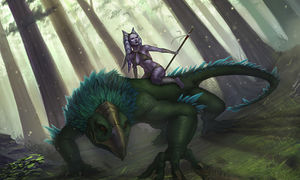 A'lora Kituri, mounted on a varactyl
A’lora was drawn to the path granted to her in visions. This had led to a series of hyperspace jumps to distant coordinates supplied to her through dreams, visions and clues along the route her father's crew had once taken. Chartering a shuttle to the mysterious location, A`lora had arrived unexpectedly along a ragtag fleet of older vessels, marked with the insignia of House Odan-Urr. Boarding the YCHT Arthos , the converted temporary mobile command center of the Jedi, A`lora was introduced as a follower of the Jedi cult on Shili, and given command over the militia`s resources; the Melewati Bushfighters, in particular. Her experience with leading hunting parties on her homeworld had made her the perfect candidate for organizing guerilla operations against the Brotherhood and One Sith forces, and these skills carried on into the Seer's first great war - the Dark Crusade.
Dark Crusade {30 ABY - 32 ABY}
- "Apetite for war is finite. All conflicts come to an end."
- ―A'lora Kituri, Jedi High General
 A'lora Kituri, Jedi General
The One Sith finally revealed themselves ina massive series of skirmishes against the Brotherhood, carving a swath of devastation for control of the ancient Sith Worlds. After the Brotherhood managed to fend off the initial invasion, the Dark Jedi declared war and began a lengthy crusade to exterminate the One Sith's powerful armies. Seeing that the Brotherhood and One Sith were both locked at each other's throats, High Councilor Liam Torun seized on the opportunity to conduct a guerrilla warfare campaign against both enemies, appointing A'lora Kituri as a Jedi General during the conflict. While the two factions were too powerful for the Jedi to openly oppose, the guerrilla campaign proved quite successful, resulting in many casualties and the salvaging of essential supplies and military equipment to strengthen House Odan-Urr.
Months had passed, along with many planets before the Jedi were able to slow the Brotherhood`s advance to a crawl. Depleted of resources, the Clans had lost their apetite for war, and returned to Brotherhood space to recover. Celebrated as a victory, the Jedi had begun preparations to cleanse these planets of Sith corruption, which would have taken years. As she would eventually find out, that fragile moment of peace was not to last.
Fall of a Mad King {32 ABY - 32 ABY}
- "“You have great feelings of hatred... Even fear. Is something on your mind, Torun?”"
- ―A'lora Kituri, soothing the High Councillor following the Renewal of Hope campaign.
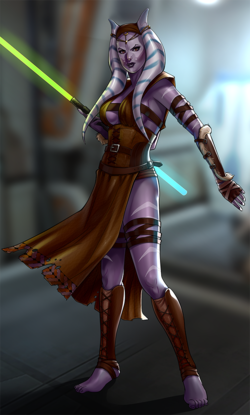 A'lora Kituri, in warrior's garb
Returning to the world Haven, the Jedi had begun preparations to launch a counterattack to Cy Thuron`s monarchy, and liberate New Tython from his iron grip. Serving as a staging point to regain resources and train the Tythonian population to join the militia, Haven was a dangerous world in its own right, but was nonetheless peaceful, serving their purposes well. Having been that the hyperspace coordinates were located through the mysterious Force by Liam Torun, it was nearly impossible to discover by anyone without the data stored within the High Councillor's navicomputer. In order to gain the proper supplies to arm the militia, A`lora had staged a successful attack on the corrupt Governor Garon, who planned a war against the Galactic Alliance in response to the restrictions on defense and military power. The covert battle on Talus was fought with utmost secrecy on both sides. Eventually, Garon was killed in his private offices, following a threat on a hostage's life.
Rallying to rearm the militia with the newly-won resources from Garon's secret military resistance, A'lora was charged with ensuring the safety of the Tythonian refugees, as reports of wildlife attacks and sickness-related deaths became more frequent. Using her skills as a hunter, she would patrol New Menat's perimeter to ward off predators who came too near. She also hunted a few of these animals for much-needed food and supplies as they were needed. Upon the arrival of Evant Taelyan, former intelligence and military leader of Scholae Palatinae, A'lora was tasked alongside Evant Taelyan and V'yr Vorsa to guide a caravan through the dangerous forests, towards a mountain range named the Spine, a major source of a valuable ore that might be traded for supplies or later refined for use on New Tython.
With a stockpile of war material and an able-bodied militia at attention, the Knights of Odan-Urr ultimately returned under the leadership of A'lora Kituri and Liam Torun to reclaim New Tython from Cy Thuron's monarchy. Leading the main assault, A'lora Kituri served as a general for the last time in a struggle to liberate Menat Ombo - the seat of power in Cy Thuron's kingdom. With an army of Harakoans freed by the combined efforts of the Knights of Allusis and Strike Team Ooroo at her back, A'lora Kituri decimated the oppressive military force from the frontlines. In the aftermath of Cy Thuron's inevitable defeat at the hands of Liam Torun, she continued to maintain the peace and harmony that once flowed through the planet. Ultimately, she discovered a former Councillor going under the alias of Izanami Kurai, a pirate from the Outer Rim formerly known as Akhera Nol. Disappearing in search of the former Aedile of Odan-Urr for a two week period, A'lora uncovered knowledge that would eventually lead to a better understanding of the Jedi.
Fading Light {32 ABY - 32 ABY}
- "There is a blindness that prevents the Jedi from fulfilling their purpose. I will see this Brotherhood to its downfall, no matter the cost."
- ―A'lora Kituri, speaking to Liam Torun on the Jedi's purpose.
 Odan-Urr assembled, during the Eleventh Great Jedi War
Months later, the Knights of Odan-Urr would return to Sith Space to continue the war against the Brotherhood and One Sith presence. It was in this time that A'lora, having received a vivid Force vision, recognized that the Jedi had become too militaristic in their actions. Failing to see past their mission in the name of "liberation," Liam Torun had lost sight of what the Jedi once were - defenders of peace. Faced with a maelstrom of conflict after the events that took hold on Begeren, A'lora Kituri shunned the Summit, focusing her efforts towards the will of the Force. While acting independent of the Summit, A'lora would find herself remaining within Sith Space, as an agent sworn to the will of the Force.
Togruta culture frowned upon individuality, and therefore A'lora Kituri broke her culture's traditions when venturing into Sith Space alone. Her difficulties in making unanimous decisions resulted in a complete reliance on the Force to provide guidance. Building a devotion to see the Brotherhood cleaned of darkness through the war, she went to lengths some would call overzealous to bring about the Brotherhood's end. Rather than seeking liberation for a lost cause, she seen a need to expunge the Sith menace through whatever means possible. This over-reliance on the Force to guide her every move led her to be entirely confident in the role she believed she was fulfilling, holding no regrets or mercy towards those who would seek to prevent her from completing her task.
The Eleventh Great Jedi War {32 ABY - 32 ABY}
- "The enemy of my enemy needn't be a friend, but a bludgeon that can be turned against them."
- ―A'lora Kituri, referring to Esoteric.
Chaos split the Brotherhood in two when Muz Ashen attempted the Final Way to gain immortality. A'lora seen the Jedi as fools for following a Sith into battle against what they believed to be the greater evil. Once again casting aside the Disciples of Odan-Urr in order to follow her own direction, A'lora Kituri sought out the One Sith armies, and join them against the Brotherhood. The Force had her believe that in siding with the One Sith, together they would be able to destroy Muz Ashen before the Rite of Immortality was completed. In a vision, she 'seen' the possible outcome of Jac falling to the Lion of Tarthos, being too weak to finish his foe and cast aside an old friend. Esoteric was to her, the perfect candidate for bringing an end to Muz Ashen's reign of malice. However, her actions had brought her a step closer towards the darkness, if even for a moment. Although still a practitioner of the Light Side of the Force, she was forced to act alongside those who used rage as their fuel for battle.
In the end, her visions matched that of the actual outcome of the conflict, although showing a different side to it. Jac was not strong enough to kill Muz Ashen when the two crossed blades on the battlefield, but where her vision faded to nothingness, Muz Ashen chose to spare Jac's life. The Lion of Tarthos disappeared, his rule ended with the stroke that killed Tarax and Esoteric stood victorious. As foretold, the triumph of the One Sith would not bring bloodshed to the Jedi of Odan-Urr, instead the Brotherhood, as they knew it, was ended; Darth Pravus rose to take over the ashes and rebuild the Brotherhood according to his own plan. Esoteric turned out to be no more than the purpose A'lora used the One Sith for - a tool and a means to an end.
Clan Odan-Urr {32 ABY - 33 ABY}
- "The Brotherhood as it was known is scattered to the Force. The Lion, vanquished. I have forseen it."
- ―A'lora Kituri, victorious on witnessing the disappearance of Muz Ashen from the Iron Throne.
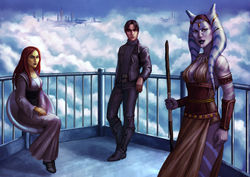 A'lora Kituri, Turel Sorenn and V'yr Vorsa
Finally, with her purpose being fulfilled, A'lora Kituri was free to follow the will of the Force, having forgotten how to trust her own judgment. Seeking to rebuild the Jedi's foundations after the collapse of a scrambling Brotherhood, the Force carried her back to lead the Disciples of Odan-Urr as a legion with renewed strength to fight back against the darkness. Reforming into the first Clan to follow the Light Side of the Force, it would be a time for change and new challenges; challenges that would test the Disciples of Odan-Urr to their limits as her visions held their focus.
Tides of Change {33 ABY - 34 ABY}
- A'lora Kituri: "I believe the Force has lead us to this point for a purpose. I may not agree with many of your clanmates, but the Force guides me"
- Atyiru Caesura Entar: "Then let the drawing of the Magical Friendship Concordat really begin!"
- ―Dajorra-Yhi Concordat is signed
Turel Sorenn first introduced A'lora Kituri to Atyiru Caesura Entar, who was instrumental in establishing the first alliance between Clan Odan-Urr and Clan Arcona in the Dajorra-Yhi Concordat. Witnessing the fall of Sanctuary and later, the extermination of "undesirables," both leaders sought to change the tides against the O'reenians and Darth Pravus' Brotherhood, driving back the former but remaining vigilant against the latter. It became evident that the conflict surrounding the undesireables needed a larger force of allies to band together and thus, the White Lotus was formed as an extension of the alliance.
A'lora Kituri herself followed Sentinel Network intelligence and her own visions to thwart the Brotherhood at each corner. This, in turn, planted a target on the Togruta's head as a threat to the Brtoherhood's new objectives. From this time forward, she realized the dangers involved in being made visible and undefended, lest the Brotherhood send their assassins to remove Odan-Urr's leadership.
Between Light and Dark {34 ABY - 34 ABY}
- Edgar Drachen: "I just wish she would be more forward about telling us what she ‘sees’ in these visions."
- Turel Sorenn: "Sometimes, we’re better off not knowing."
- ―Edgar Drachen and Turel Sorenn discuss the High Councillor's absence from the Battle of Florrum
 A'lora Kituri and Turel Sorenn discuss Odan-Urr's involvement in the Vatali Empire with Empress Kaltani Anasaye
Under Darth Pravus, the Dark Jedi fell in line beneath the authority of his command. Donning the mantle had given him absolute control over the Dark Council, after torturing his former Herald, V'yr Vorsa before her escape. On returning to the Jedi, she was given little time to warn Odan-Urr of a Brotherhood attack, aimed with the sole purpose of turning the seas to glass. Aabsdu Dupar, despite being di Plagia, attempted to convince Pravus to spare the planet before being put into his place. The Brotherhood fleet decimated the surface, targeting Menat Ombo, the Arca Praxeum, and a host of other facilities before continuing the bombardment. The Jedi were believed to have perished on the surface, or scattered to the winds. In the aftermath, A'lora allowed Mar Sûl to lead a team in boarding the *Despoiler*, a shuttle holding Pravus' favorite treasures from New Tython to recover Solari's fragments.
Now marked enemies of the Brotherhood, the Jedi once again banded together to gain support from "undesirable" factions on Florrum. However, their efforts were intercepted by Plagueis forces and a retreat was called for, leaving with just a handful of refugees. After their defeat at the hands of their enemies, the Jedi once again disappeared — this time for several months, and outside of Brotherhood space.
Homecoming {34 ABY - 34 ABY}
- Jo Mizu: "What should we call it?"
- A'lora Kituri: "What else would we call home?"
- ―A'lora Kituri, on naming the new Arca Praxeum
Becoming separated from A'lora Kituri shortly after the battle on Florrum, Clan Odan-Urr made for the Nilgaard System, far from Pravus' stranglehold and outside of his domain. Eventually, his attention wavered and the Jedi were no longer considered a threat — more a nuisance. A'lora Kituri, on the other hand, travelled through Brotherhood space with the Inquisitorious tracking her movements in order to give the Jedi time to leave without drawing attention. With the secret aid of Morgan Sorenn, her tracks were covered and she regrouped with Odan-Urr in the Kiast System.
Empress Kaltani Anasaye had arranged for a meeting with the High Councillor on the capital, extending shelter in exchange for Odan-Urr's assistance in removing the system from all star charts, navigations and routes; a fortress of secrecy and inaccessibility was erected around the system to deter incursions against the Brotherhood or First Order. Formerly allied with the New Republic, the Vatali Empire sought to cut ties after the destruction of Hosnian Prime and turned to Odan-Urr for assistance. As a result, Odan-Urr was given place among the Vatali as citizens.
The Inquisitorius {35 ABY - 35 ABY}
- "I won't let you place yourself in danger needlessly, but if I need to follow you to the ends of this galaxy, then so be it."
- ―V'yr Vorsa
 A'lora Kituri, on the run from the Inquisitorious
Looming from the shadows stood the threat of Pravus' Inquisitorius. A'lora, knowing full well that she would be undoubtedly marked for assassination, fled Kiast to wage her own battle against the Brotherhood and to lead them off the scent of the Vatali homeworld. Followed by V'yr Vorsa — who wished to ensure that her companion did not succumb to the dark side of the Force — she found herself traversing Brotherhood Space, breaking Pravus' plans wherever she could, drawing the attention of his most skilled trackers. Eventually, she joined with V'yr Vorsa, who invited her aboard the Tortoise as she eluded the Inquisitorius' assassins.
Eventually, her trackers had been recalled to the Brotherhood's new capital, Arx, following the directive of the Brotherhood's latest Grand Master, Telaris "Mav" Cantor. Those who still believed the former High Councillor to be a danger to the Brotherhood, or retaining loyalties to the disappeared Grand Master Darth Pravus, continued in pursuit, now excommunicated from the Inquisitorius' ranks.
Her hunt continued in earnest for a time, living on as a dangerous game of cat-and-mouse. With the would-be assassins acting of their own accord, the Togruta eluded their efforts all while reversing her role as the hunted. Now the hunter, and with the blessings — or rather, a silent nod — of the Brotherhood's Voice, A'lora dismantled the efforts of her traitorous tails with the assistance of V'yr Vorsa and was freed to pursue her own newfound goals.
Seeker of Lost Knowledge {35 ABY - 35 ABY}
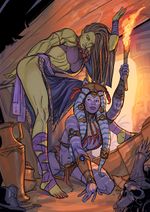
- "This place... it is strong in the Living Force. I can feel it."
- ―V'yr Vorsa
Freed from wandering as a fugitive, A'lora Kituri's lust to see the Brotherhood crumble faded behind a willingness to seek and teach the secrets of Jedi sects long thought lost. Following a newfound belief in rekindling these old teachings in the mentorship of younger generations of Jedi, she re-united herself with her former Councillors of Odan-Urr to take on the responsibilities she had neglected during a tumultuous war against Darth Pravus' New Order. Entrusting her Neti companion, V'yr Vorsa, to the continued monitoring of her emotions, the Togruta struggled at times to let go of past transgressions and to focus instead on what lie ahead.
For a time, the two travelled to locate the ancient temple of a Force-using civilization, whose energies had formed a Nexus of force energies contained in a shallow pool. The knowledge and scriptures found within on the walls formed the basis of an understanding that led to the investigation of the Velestari Temple — a former teaching center on Kiast for those gifted with Force abilities. Shortly thereafter, A'lora began teaching in earnest at the Jedi Praxeum on Kiast and collected a reputation as a harsh instructor with little room for patience.
Teacher of Lost Knowledge {35 ABY - Current}
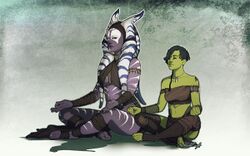
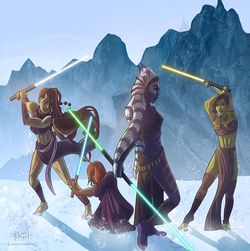
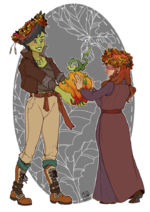
As Arx fell under siege, A'lora Kituri found herself on an LAAT/i gunship to the planet's surface. What was once a symbol of the Dark Council's iron will and control over its denizens now became littered with the scars of battle. Wandering the smoldering wreckage of the Brotherhood's crown jewel, A'lora found herself on her own path to settle old scores. Encountering the remaining vestiges of Darth Pravus' rogue inquisitors, A'lora had come across another relic of another time — the last remaining colonies of New Tython, settled on Arx as civillian refugees. For how long these people have lived under the Brotherhood's rule, she hadn't known; nor was she aware of the nature of their arrival. As it turned out, these refugees were of a varied background — while some were indeed refugees, smuggled on-world, others were indeed citizens of Arx with their own families. With a newfound understanding, A'lora led those who wished to flee the battle to an awaiting hoversled, which brought these final refugees to the safety of the Odan-Urr fleet above Arx. After the battle was ended, it was left to the denizens of Arx to decide whether to be taken to Kiast and reunited with their people, or to live their lives on Arx, where many had established their lives and families.
Among those rescued and returned to Kiast was a teenaged Mirialan girl, who at one time might have been considered too old to be trained as a Jedi Knight. However, possessing little attachments following the bombardment of New Tython and left without family, A'lora Kituri took on the girl as her own Padawan. Oriana was the girl's name, and so A'lora began teaching the Padawan in the ways of the Jedi of old — teachings dating back to the High Republic. In her training alongside the other Padawans, Oriana formed few friendships, given that she was delinquent with little respect for instructions. Indeed, most considered the young Mirialan unsuitable for training as a Jedi Knight and she tested her master's patience and short temper more often than not. It wasn't until she began to attend training with A'lora's longtime friend and mentor V'yr Vorsa that she grew closer with one of her fellow students in a sibling-like manner; a Miralukan Padawan by the name of Larun — younger than Oriana and shy, but the Mirialan grew a fondness for the Neti's Padawan. Perhaps, their bond was due to their own distinct status as the "outliers" in the Praxuem, or rather their lack of friends. Whatever the case might have been, Oriana watched over the Miraluka as if an older sister to the younger Padawan.
Physical Appearance
 A'lora Kituri, on Kiast
On the surface, A'lora Kituri is as ferocious as she is beautiful. Encased in pure white flesh, the hollow protrusions of her montrals, are shorter than average for her species. Framing fierce - yet attractive - features, her lekku are decorated in a mesmerizing pattern of blue stripes which extend to her montrals, forming dark cerulean caps at their summit. Lavender-skinned with white markings, her skin takes on an exotic shade for her species and serves as camoflage in certain environments.
Maintaining a lithe but muscular figure lends to her boundless athletic talent. Well-toned and muscular, she is able-bodied with a curvacious figure that could easily be mistaken for that of a dancer than a warrior. Standing at a slightly less than average height for her species, her montrals still make her taller than the females of most other species and thus make her less able to blend into a crowd of other near-Humans.
Her savage nature is most evident in her darkened face. Prominient upper cheekbones and angular brows contribute towards a fierce and almost intimidating appearance, hinting at a lifetime bent on survival. Deep-set amber eyes provide a stark contrast to otherwise striking features, being constantly shadowed within their sockets. Stained several shades darker than her skin, her thin lips are a deep shade of violet than the rest of her face. Combined with a natural pattern of white markings covering most of her face, her devotion to the life of a warrior-seer is unmistakable, even to the most unpracticed gaze.
Attire
Sharing a deep connection with her surroundings has made A'lora Kituri forego the traditional Jedi robes in favour of lighter and less restrictive attire than traditional Jedi clothing. Handcrafted, her preferences are towards garments tooled from raw, natural cloth, oftentimes minimalist in form and function and sometimes considered "immodest." These articles are tight-fitting as to not become a hindrance while performing acrobatic maneuvers. As a result, her usual attire is far more revealing than standard tunics and are best suited towards lush, forested terrain. Alterations can conform her wardrobe to her surroundings, adding furs, leathers, ivory, and even bronze to the ensemble.
Philosophies and Beliefs
Force Beliefs
Once a student under the tutelage of Shaak Ti's teachings, as recorded in stories, tales and legends, A'lora Kituri formed a fragmented understanding of the Jedi Order and its teachings. Without a true Jedi instructor, her reliance on oral legends left out several of the Jedi Order's most basic values. Of her deviations from the Jedi Code, the most recognizable shows when she is engaged in battle and a primal ferociousness guides her actions. While the techniques she had learned from these stories allow for little physical manipulations in her environment such as through telekinesis, the coherent ones have allowed her the ability to create intricate illusions designed to fool the most observant individuals. Although a rare talent, A'lora Kituri has mastered the gift of farsight to see and act on the distant future. Believing these visions to be the Will of the Force, as she understand it, she holds an unshakable devotion to following their messages.
Togruta Beliefs
A'lora Kituri has a strong sense of unity and togetherness, a quality inherited from her homeworld, Shili. On her native homeworld of Shili, the pack relied on each other and would band together to take a stand against the massive monsters that hunted them, staving away Akul attacks as well as any predators that would occasionally wander too close to their territory. A'lora is known within House Odan-Urr for her habit of not wearing shoes when in lush environments, believing that the land was spiritually connected to the Togruta, and wearing shoes severed the bond between herself and the land. In addition to her beliefs, A'lora often thinks of her House as a pack. In Togruta custom, within a pack every able Togruta was expected to contribute his or her own share, to the betterment of the pack, where each individual is treated equally. Togruta were also known for their belief that those who could not keep up should be left to fend for themselves, because that is nature's way. This belief was abandoned when she became involved with Master Shaak Ti's teachings, and replaced with a devotion towards helping the helpless.
Relationships
V'yr Vorsa

Councillor V'yr Vorsa has remained the Togruta's greatest companion throughout her time within Odan-Urr. The Neti's presence in the Living Force has linked itself to A'lora through a deep connection shared in their similar environments. As attuned to nature as the Shili-born Togruta, this common ground formed the basis of a long friendship between the two Jedi. Both were rooted within the Living Force as beings connected to everything around them; A'lora's tribal upbringing and Vorsa's plant-like appearance cemented their awareness to nature. While at first, Vorsa seen the young warrior-seer as little more than a child, she has grown closer to the Togruta, seeing her fellow Jedi as a sister. As a general, Vorsa has proven herself with a talent for resolving issues of command and a staunch combatant when called upon to aid A'lora in matters of leadership. Over time, these bonds have strengthened to the point of the two being completely synchronized on the battlefield, their movements and complicated maneuvers intertwined without so much as a transferred thought.
Despite these similarities and connections, the two have shared disagreements on multiple occasions. Headstrong in her devotion to the Force's will, A'lora had been known to follow her visions with little regard towards the Neti's advice on matters that have been foreseen. Ultimately, this led to the two being separated on two sides of the same conflict during the Eleventh Great Jedi War, where A'lora Kituri sided with Esoteric and Vorsa with Jac Cotelin.
Turel Sorenn

Turel Sorenn took V'yr Vorsa's place at A'lora's side as Proconsul after the Neti left as the Grand Master's Herald. While she understands Turel's strengths and her need to have his guidance in Vorsa's stead, the Jedi has become something of a nuisance in her leadership. Possessing the innate talent of stripping her of all patience, he remains one of the few to have ever drawn the Togruta's full wrath more than once — often in the form of blackened and bruised features. She despises his presence whenever a sarcastic comment leaves his mouth, but values his valour on the field of battle and devotion to his Clan.
Atyiru Caesura Entar

Atyiru Caesura Entar, now deceased, was one of A'lora's most trusted friends outside of Clan Odan-Urr. Having been introduced to the Ashla and Bogan-worshipping Miraluka through Turel Sorenn, the two formed a friendship from a written bond — the Dajorra-Yhi Concordat. Building off this alliance, the two had grown to trust one another, having faith in each other's motives and abilities. Since their first time meeting aboard the NSD Invicta for the negotiations of the alliance, A'lora has gravitated ever closer to following certain Arconan values. She has learned much from Atyiru that has aided in making Odan-Urr a formidable opponent against the Brotherhood's might, returning the favour with her own advice.
However, as professional as their friendship might seem, A'lora cannot see past the Consul's unwavering smile, even when hard-pressed into the worst circumstances. As a result, a lot of the Arconan's mischievous tendencies confuse A'lora, seeming as little more than nonsensical outbursts of joy. While this can wear on the Togruta's patience in a formal setting, it has never sparked an outward show of annoyance.