
|
This map's not complete. It's just a piece. This page is flagged for further work under the Clan Arcona article improvement drive.
Expected changes include: General updates
After improvement is complete, please place a note on the article's talk page and remove this message.
|
|
| Selenian
|
|
Sentient
|
|
Selen
|
|
|
|
60-90 years
|
|
|
- Sergeant Jennel "Jen" Jelenko
|
|
1.4m-2m
|
|
|
|
|
|
|
- Dark or light striped skin
- Brightly colored features
|
Biology and Appearance
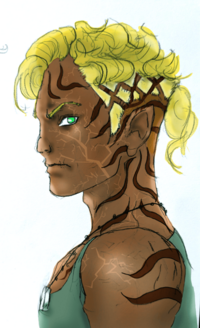
Selenians are Near-Human humanoids, often tall, most of bright and vibrant eye colors and light of hair in golden shades, distinctive with light or dark striping on their skin in varying degrees. Traits such as dark hair or eye colors and pale skin have also become incidental in their biology, but are the product of Selenians intermingling with other non-native species.
Ancient Selenians had more extensive nonhuman traits, including small to medium-length horns on their heads, cat-eyed night vision, and sharp teeth. Some tribes even displayed webbed digits or digitigrade limbs. Their bright coloring and striping was camouflage for the jungles they lived in, or a faux warning of poison to equally bright native predators. These traits all faded over time, though, and now in the majority of the population, only the skin striping remains. In some of the more traditional tribes with less foreign admixture, such as the people of Vilcaja, the Tri'Agiul Islands, and the tundra-dwellers of Tunca and Pari, many of these vestigial traits occur with greater frequency, though it is still rare at about two-to-three percent of those populations.
History
Ancient
Ancient Selenians were divided into three main tribes: the Plainsrunners, the Forestfolk, and the Deeplurkers. The Plainsrunners mostly lived on Apaec, the Forestfolk on Ussun, and the Deeplurkers on the fringes of both "continents," the largest of the Selenian islands, holding their semi-aquatic homes on the smallest islands off the coasts. All three tribes eventually expanded after evolution of water travel by boat or raft, becoming sailing peoples.
Plainsrunners colonized the Tri'Agiul Islands while Forestfolk eventually made their way to what is present-day referred to as the Ring of Fire and its nearby isles. The Deeplurkers went far north and south, to the ice caps of Pari and Tunca. Eventually, Selenians began trading with one another and homogenizing, and all the islands on their watery world became settlements, tribes meeting and intermingling at intervals while others stayed more isolated.
Over the years, the old tribes mixed, fell apart, reformed, and repeated the cycle. Modern Selenians have blood from all of their old tribes and from many outsiders as Selen was "discovered" by intergalactic traders or drifters. Only on the more isolated or traditional islands and in deeply rooted tribes do older practices and purer bloodlines remain, worshipping a variety of old gods from a multitude of old Selenian pantheons. After Clan Arcona's establishment, the Citadel and its magic users became embedded in Selenian lore and life around Ussun, sometimes to the point of religiosity, and the expansion of trade and establishment of an overarching government slowly diluted the old Selenian ways even further.
Modern
Whether living in one of Selen's five major cities or in the more remote villages dotting its surface, few Native Selenians in the modern era are unaware of the foreign presence operating on the planet. Since its relocation to the Dajorra System following the events of The Exodus in 19 ABY, Clan Arcona has established itself as the preeminent power over the Selenian people. Until the recent events of the Battle of Brimstone, the Shadesworn of Clan Arcona ruled over the system in secret, but the devastating final encounter with the Dark Side adherents (who lived as gods amongst the Selenian people in ages past) forced the Clan to be more transparent with the people of the Dajorra System. More to this point, the reorganization of the system's government in 42 ABY has led to more political power being placed in the hands of the citizens of the Dajorra System, resulting in a marked increase in Selenian representation in all levels of Dajorran government.
Society
Selenians are generally a very reserved species who tend to distance themselves from the surrounding galaxy, concentrating mainly on the ecology of their planet and the work of their complex hydrodynamics and architecture. This tendency toward isolation is likely due to Selen's location deep within the Akkadese Maelstrom, which effectively cuts them off from the rest of the galaxy; moreover, their comparatively late development of long distance space travel contributes to this as well.
They have five major cities, including their capital, Estle City. The "mainlanders" of the larger islands of Ussun and the lowlands of Apaec, with their major cities, tend to be more culturally and economically diverse, whereas tribal populations on smaller islands range from isolationist to outright hostile towards outside galactic influences. Selenians tend to be quite traditional outside major cities and trade hubs, preferring many more of the culture's older practices, but they are also generally peaceful, their oral traditions warning against war and bloodshed.
It is said two things of every Selenian: "all can swim, all can build." An equally common saying: "if I've got two hands," similarly refers to these practices, that any Selenian will always be able to navigate their ocean world and create more than what was once there. They pride themselves on their tightly knit, collectivistic communities and their self-sufficient civilizations, abhorring anything seen as extreme wastefulness and generally reverent of nature as a people.