
|
| Interitus Cairn
|
|
Outer Rim
|
|
Seitia Sector
|
|
Caelus
|
|
Caelus
|
|
Despir, Vigil
|
|
I-19
|
|
26.35 standard hours
|
|
5,101 standard days
|
|
Terrestrial
|
|
16,200 km
|
|
Type I (Breathable) High levels of oxygen
|
- Tropical Western Reaches
- Humid Subtropical
- Humid Continental
- Dry Central Continental
|
|
Heavy (1.268 Standard)
|
- Rocky Shorelines
- Volcanic Magma Fronts
- Savannah
- Deadly Desert
- Mountainous Interior
- Large Tidal Floodplains
- Open Grasslands
- Temperate Forests
- Tropical Jungles
- Lakes and Rivers
- Sizable Oceans (50% of surface)
|
|
Humanoids, Twi’leks, Bothans, Mon Calamarian, Sullustan
|
|
Human
|
|
Basic
|
|
|
|
|
- Ores
- Medicine
- Alcohol
- Technology
- Grains
|
- Military Weaponry
- Exotic Food Stuffs
- Pelts
- Meat
|
|
|
History
Once considered part of the pinnacle worlds of the Caelus system, in 232 BBY Interitus Cairn was struck by two successive fragments of the Emergence that had sling-shot around a massive black hole from wild space, returned to the known systems and struck the planet. Striking near the central capital, millions of lives were lost as was the capital itself. Much of the interior landscape was forever altered by the impact, with significant seismic activity in the centuries after, preventing nearly all resettlement efforts by the survivors. Technology largely collapsed, with the survivors returning to a primitive way of life.
Eventually, much of the world’s past became forgotten except what was passed down through the generations. Even the former capital’s name has fallen into obscurity, with various tribes calling it different names as their ancestors remembered it. Due to the seismic activity and tsunami risks, Interitus Cairn was never re-settled by outsiders and was largely left to its own devices. It was considered far too risky of an investment, with far too little in return, and forgotten by all but the most persistent dreamers.
With the Dalicron War persisting, as well as the conflict between the Traditionalists and the Loyalists, some have begun to eye the world as a potential salvation…
Interitus Cairn World Map
 Interitus Cairn World Map
Landmarks
Thanadris - Western Continent
- Main article: Thanadris
Sunken City - Eastern Continent
TBA
Despir & Vigil
Interitus Cairn has two moons that orbit it, Despir and Vigil. Vigil is a lifeless rock that slowly orbits in a clockwise pattern, with each full lunar cycle taking a month to complete.
It's smaller twin, Despir, is an extremely hot magma moon. It too, orbits in a clockwise pattern with each full lunar cycle taking half a month to complete. Its unique feature, however, is when it comes into alignment and close proximity to Vigil. When this occurs, the outer crust is shattered to reveal the lava underneath which scorches the skies of Interitus Cairn with a crimson red. At night, everything glows red, and some tribes give sacrifices feeling that this "blood moon" is an omen.
Regions
Eastern Continent
The Eastern Continent, also known as [NAME PENDING], consists of 9 unique regions. It was the first of the two major continents to show solid signs of seismic calming in recent decades. Because of the northeasterly trade winds, due to the planet’s axis, and the mountainous growth from the seismic shifts, much of the continent’s heart is covered in lush forests and plains. In the northwest, however, there is a significant arid area both due to the cool trade winds being unable to reach it, because of the mountain ranges on its southern rim, as well as the hot moistureless air that comes in from the active volcanic island to its west.
Volcanic Island
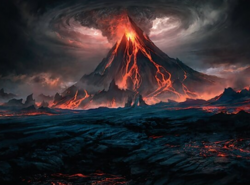 A distant view of the volcanic island.
 This tall Composite Volcano is a testament to the still potentially volatile nature of the planet, with its classic and distinctive volcano peak, as well as frequent violent eruptions and a constant flow of magma to the surface. Only the most resilient of creatures can exist near the summit of the volcano, with high heat and noxious gases being a constant threat. Down at the coast, where the lava flows freely into the ocean and ever expands the size of the island, conditions are slightly more favorable for life to exist. Occasional trees sprout from seeds carried by the winds and waves. Vibrantly colorful blooms of algae grow beneath the surface of the water all around the island, absorbing the myriad of minerals extruded from the volcano. Tikwaw birds, a native species to Interitus Cairn, prowl the near-boiling waters feasting on the algae, protected from the temperatures by their thick scales and long legs. The algae gives them their bright and varied feather colors. On the southern peninsula, a narrow crevice opens up into the inside of a massive underground geode hundreds of meters across.
Claylands
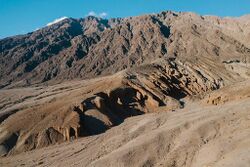 The Claylands.
 Trapped between a wide mountain range that blocks the trade winds from the south, and a huge volcanic island sending hot, moisture-less air east, this region has struggled to recover, even after all this time. The only precipitation here is during the peak of summer months when the tropical storms move north, but thick layers of clay on the surface provide nowhere for the water to go, creating a landscape of small hills with crevices between them where the water pooled. Life in this region is almost nonexistent, but for a few areas. On the northern coast, more frequent rain and humid air have washed away the layers of clay and allowed some flora to adapt. Likewise, a large lake in the center has begun to show signs of life, presumably due to a similar erosion. To the south, the badlands encroach on the jungles to the east. Far beneath the surface, where the soil begins to soften, a maze of interconnecting rainwater tunnels is expanding. The cooler temperatures and moisture allows some flora to propagate underground.
Interior Coastal
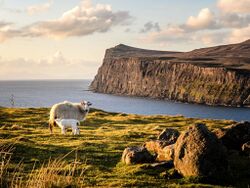 Coastal view into the ocean.
 This mountainous region was once a vibrant coastal peninsula, but the violent shifting of tectonic plates after the Emergence redefined the entire landscape, annihilating several settlements in the process. This destruction continued all the way to the south-western edge of the region, where a large city was cleaved nearly in two, half sinking below the watery depths and the other half remaining on the shores to be reclaimed by nature. The plant life of this region is temperate, with a mix of deciduous and evergreen trees. With many ruins scattered throughout the peaks, this region is ripe for technology scavenging by tribes from across the continent, though few have ventured into the Sunken City itself and returned to tell of its secrets.
Crescent Isles
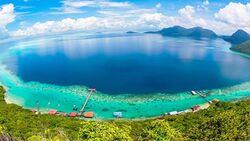 The Crescent Isles
Many dozens of millenia before the Emergence devastated Interitus Cairn, this region was formed from the collision of a sizable meteor. Ocean water flowed into the crater, creating a ringed landmass around the site. Ocean currents eroded the outer portion of the ring, severing the connection at multiple points and creating a series of islands. This separation caused many of the animals to diverge in evolution, creating distinct subspecies on each island. The largest of the islands in this region is essentially divided into two sections by a sharp, jagged mountain range. The northern section is populated with areas of dense evergreen forest separated by smaller, but equally jagged mountains. Woodland creatures have flourished in this environment, taking advantage of the year-round cover of the trees. The southern section is much more open, with occasional patches of forest and wide meadows allowing for larger, less agile creatures to graze; however, with larger prey comes larger predators.
Grasslands (North, Central, Southern)
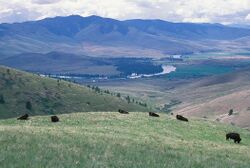 The Central Grasslands
When the tectonic plates were thrown into turmoil by the Emergence, this valley region was split horizontally into three distinct regions, creating an entirely new river systems in the process. As the chaos settled, the new features allowed this region to flourish when others around it struggled. Strong, bountiful forests developed in the northeast at the base of the river, while in the heart of the region plains provided ample room for animals to graze. In the west where the river meets the sea, a dense jungle formed on the coast. Nomadic peoples found refuge in this region in the aftermath and formed tribes before spreading out around the continent.
Frostlands (East)
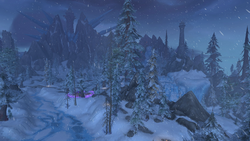 Deep within the Frostlands
Prior to the Emergence, this region was an hospitable and flourishing tundra. Powerful trade winds after the Emergence brought frequent storms that, combined with the plummeting temperatures, prevented most flora and fauna from continuing to live here. It only worsened in the aftermath of the disaster when jagged peaks burst out of the landscape, burying the ruins of what little signs of civilization may have remained. Even now this region remains mostly snowy and lifeless, aside from small pockets of resilient flora.
Frostlands (West)
In the apocalyptic aftermath of the Emergence, the southern coastal regions of this continent were bombarded by monolithic tidal waves; no region suffered more than this one. Entire cities were dragged into the depths. When the icy waters finally receded, all but the most stalwart structures had been completely washed away. What was once a solid coastline had been broken into four separate peninsulas. Over time the trees returned, then the wildlife, and finally, the people. Nomadic tribes wandering into this region from the north took up residence in several abandoned geothermal power plants that laid dormant in the mountains. These tribes eventually settled down and consolidated into one large society, developing their own technology from scavenged relics.
Scorched Lands
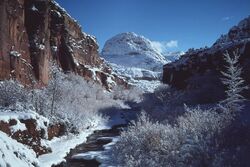 The Scorched Lands
This scorched, cold arid region has sparse creatures and vegetation spread out in the shadows of the many towering rock formations. The temperatures here have increasingly became colder and colder, with far more competition for what flora remains. This has resulted in many more predator type creatures fighting over territory. In the center lies a massive saltwater lake that was once a part of the ocean to the north. During the tectonic upheaval after the Emergence, a large section of the ocean floor rose to the surface, creating a land bridge that separated the lake from the rest of the ocean. Aquatic lifeforms found in the lake, both flora and fauna, vary uniquely from those found in the nearby ocean.
Western Continent
The Western Continent, also known as [NAME PENDING], was the second of the two major continents to finally show signs of seismic calming, however much of its eastern side remains unable to be settled or explored due to the constant seismic activity within the mountain chains south of the continent. The effects of which have blocked the cooler moist air, instead redirecting it over the western sections. This has resulted in a significant desert area persisting despite the scientists efforts to make it otherwise.
An unexpected side effect of this, however, was the formation of a savannah style region in the northeast that was significantly above sea level, and did manage to take in some of the cooler air which rose above the wastes to its south. Directly to its southeast was a passageway to a basin at the ocean’s edge where a smaller jungle formed due to the winds off of the northern ocean.
In the southwestern, western, and northwestern regions are large woodlands and forests along with what some refer to as the ‘’’World Tree’’, a Wroshyr tree that was imported from Kashyyyk to jump-start forest and jungle development. The scientists were unaware of just how fast that particular tree grows, however, and quickly its root systems delved deep into Interitus Cairn’s surface and all across the western continent. It acquired its moniker due to this, and the fact that roots which penetrated the surface in other areas of the forest and jungles saw additional nutrients fed into the ground from those roots.
Forests
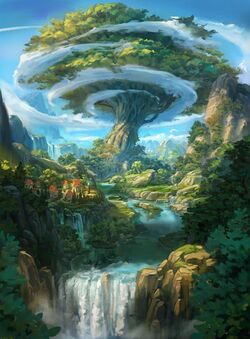 The World Tree of Interitus Cairn, within the western forests.
Spanning nearly forty percent of the Western Continent, the Forest lies on the northwestern side of the continent. It was created after the placement of a Wroshyr Tree centuries prior, and managed to escape the effects of the Emergence due to its thick roots holding much of the area together tightly. Because of the region’s stability, this was one of the major areas where survivors of the Emergence resettled after the capital’s collapse over 300 years ago.
Many of the tribes here became isolated from tribes in other regions, with some that settled near the World Tree adopting a spiritual belief about the tree due to its protections given to them and not others. These tribes in particular have become hostile to outsiders, feeling they ‘are not worthy’ due to the tree not affording them protections.
This region is also home to Thanadris, and the Jedi Ruins.
Southwest Archipelago Region
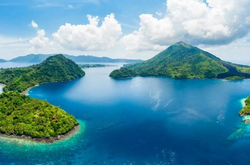 The Archipelago.
Located on the southwestern coastline, the archipelago’s mountain ranges protected it from much of the Emergence including the tsunami effects within the continental heart. It consists of numerous islands and coastal areas, with many small settlements dotting around the interior perimeter. Following the Emergence, it became home to numerous tribes which adopted the lives of pirates over the generations.
As infighting became more common, an enclave was created that was under the control of a ‘pirate council’ from leaders within each tribe to bring about a common peace between them and a goal of plunder and loot from tribes not a part of the enclave, and towns outside of the archipelago. Due to the tsunamis and storms, they have largely been unable to leave the exterior perimeter of the archipelago and make their way up the eastern or western coastline. As the tsunamis and seismic activities from the Emergence calm, however, this could change.
Southeastern Isles
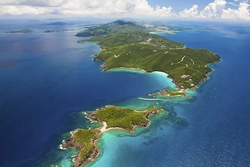 The Southeastern Isles.
The southeastern isles are a largely unpopulated area, filled with avian wildlife capable of staying above the tsunami strikes when they do occur on the islands. In the past, these islands were significantly larger but were whittled down following the Emergence and its effects within the continental heart.
With the calming of tsunami frequency, these islands are becoming an opportunity for those who want to be away from the mainland style of life.
Northwest Desert
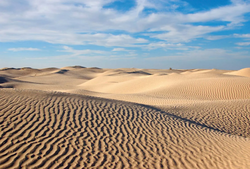 The Desert.
The central desert of the western continent was created following the effects of the Emergence and the reshaping of much of the interior of the continental heart between the two continents. Much of the cooler air was directed away, with only arid air remaining. This resulted in desertification of the region over the centuries, and only memories remaining of what was once here long ago.
Nicknamed the ‘deadly desert’, it is rumored to be filled with buried temples and cities but is also home to the dangerous antlion which calls the dunes its home. Other creatures of a deadly nature call this area home, including snakes and other various wildlife. In addition, the super-high temperatures and lack of water also present a danger to anything not accustomed to the environment.
Red Wastes
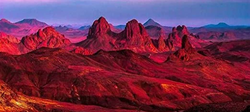 The hostile lands of the Red Wastes.
The Red Wastes, as they are called, was once the region where the former world capital of Interitus Cairn existed. It was on the eastern seaboard that the Emergence struck the planet and caused its havoc, not far from the capital. The collision ripped open the crust of the planet and exposed the liquid magma mantle beneath, pulling it to the surface. As the lava on the edge of the crater cooled, it formed into a massive lava lake that still persists. The lake covers such a wide area that it is subject to lunar tides. Much of this area has remained untouched in the centuries after, with ‘cairns’ created in memoria for those who had perished in the event. Because of that, this region is dotted with thousands of cairns.
Visiting here has become far too much of a hazard, however, as magma pressure beneath the surface will occasionally build up and rupture, showering the landscape in molten rock. What little technology did remain was scavenged, and is now in the hands of rogue swoop biker gangs which patrol the region and kill or enslave those who dare encroach on their territory. Sometimes even putting them in domes to fight one another for their own amusement.
Northern Canyons
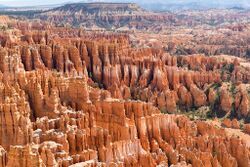 The sprawling Northeastern Canyons.
With little mountains to defend this area when the Emergence struck, and the roots of the World Tree not reaching this far north, it was the most heavily affected area with seismic activity outside of the desert areas that saw the worst. Constant tsunami effects from the interior eroded and broke away much of the rock, forming vast canyons and crevices that descend far into the planet’s interior. While it is not understood why this area took so much damage, observers from orbit over the years speculated that a large majority of the seismic activity centered on underground fault lines that stretched across the area like a spider web, resulting in its eventual creation to what it is today.
Carrions and other avian scavengers control much of the area, with smaller wildlife being able to survive the environment by getting into smaller areas where the avians are unable to reach.
Northeastern Savannah
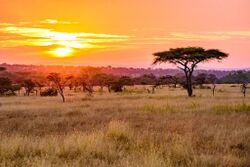 The Savannah
Because of its high elevation in comparison to much of the rest of the western continent of Interitus Cairn, and the canyons taking the brunt of the seismic activity in the area, the Savannah largely escaped the effects of the Emergence. It consists of a large grassland with trees dotted throughout, various oases, and has a large wildlife standing throughout it including prides of wolves, cats, and hyenas. On the exterior there are more lush areas where non-predatory wildlife thrive, away from the more territorial and hunting types of wildlife.
At some point, though it is unknown when, a reprogrammed battle droid sect came to care for the savannah and patrols it constantly for poachers and outsiders that do not belong. The sect is under the control of the droid S73V3 1RW1N, who serves as the savannah’s primary caretaker.
Northeastern Jungle
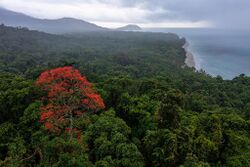 The thick Jungle
East of the Savannah, beyond the mountain ranges, lies an isolated section of jungle. The elevation here drops dramatically from the jagged peaks down to sea level. Warm humid air trapped by the mountains caused this region to flourish, in some cases too much so, as many of the jungle trees here are two to three times larger than their normal counterparts; though they pale in size to the World Tree. Some sections of the canopy are so dense the jungle floor is in near complete darkness. Small bushes and other ground level flora are less common here. The theme of increased size continues with the pollinators of this region; a gargantuan breed of Honey Bee can be found within the canopies. With drones the size of speeder bikes, no one is certain how large the queen is. They have taken over a significant portion of the jungle to the north, converting it into a massive hive. The drones collect for their honey within the Jungle, but even venture out into the Savannah and south past the Volcano. This variation of bee lacks the normal venom applied via stinger, however there is a stinging poison present in the honey, which the bees are immune to. It acts as a strong deterrent for most creatures, but someone with a high enough pain tolerance may find it enjoyable.
The jungle continues across a narrow channel and onto a long island to the east, though the size and density of the trees begins to decrease. Medium size hills break up the jungle, keeping the trees spread out and the canopies thin, allowing for more ground flora to grow. On the southern tip of the island, the hilly terrain combines into a substantial mountain peak.