|
| Kapsina
|
|
Core Worlds
|
|
Jusadih System
|
|
Sigil
|
|
Nasva
|
|
194 Days
|
|
Type II
|
|
Barren
|
|
0.99 Factors
|
|
Desert
|
|
None
|
|
None
|
|
Ruins
|
|
|
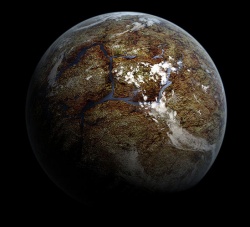
Kapsina, also known as Sigil I, is the capital world of the Jusadih System and the former headquarters of Clan Plagueis. Once a thriving oceanic world rich in mineral resources and Adegan crystal deposits, the planet was transformed into a barren wasteland after the devastation of its biosphere during the Horizons Crisis in 30 ABY. Today the planet remains largely uninhabitable, its surface dominated by deserts, violent dust storms, and the skeletal ruins of its former cities.
Despite its devastation, Kapsina remains historically significant to the Dark Jedi Brotherhood. The world once served as the center of power for Clan Plagueis and the site of numerous events that shaped the clan's early history.
Following the return of Faethor Dejarc in 41 ABY, the ruined world once again became strategically important when the remnants of the Eternal Order established their hidden center of power within the ruins of the former Plagueian capital.
History
 Kapsina before the devastation of its biosphere.
The world now known as Kapsina formed from debris orbiting the star Sigil. The planet was originally cataloged as Sigil I before later being named after the scientist who first documented it, Dr. Kapsina. Early records of the discovery were eventually lost within the vast archives of the Old Republic, leaving the world largely unexplored for centuries.
In its earliest known era, Kapsina was a water-rich planet dominated by immense oceans. Over thousands of years the increasing heat of its star gradually altered the world’s climate, causing large portions of those oceans to evaporate and leaving vast stretches of arid terrain behind. Even so, the planet retained small seas and extensive mineral deposits beneath its surface.
The first known native culture on Kapsina was the Myrsei, a self-sustaining society devoted to craftsmanship and harmony with the planet’s environment. Their culture emphasized artistic perfection and the forging of exceptional tools and weapons.
Eventually the planet attracted offworld settlers drawn by the wealth of mineral resources hidden beneath its deserts. Mining corporations established large industrial centers, and population growth followed as families settled near the expanding operations.
Dark Brotherhood Interest
The Dark Jedi Brotherhood eventually took interest in Kapsina due to its valuable resources and the presence of Adegan crystal veins. These materials proved useful in the construction of starfighters and capital ships used by the Brotherhood.
The Dark Council dispatched an Envoy to survey the planet, ultimately purchasing a mining corporation that would later contribute significant materials toward the construction of the Antei Defense Groups.
This arrangement continued until 22 ABY, when the formation of Clan Plagueis brought renewed attention to the Jusadih System. The clan relocated its base of operations from the Acarr System and constructed a monumental headquarters within the corporate city of Ellesmeria. From that point forward, Kapsina served as the primary homeworld and political center of Clan Plagueis.
Alien Incursion
In 21 ABY, alien forces invaded the Jusadih System. Kapsina was the fourth world along their route following Shintera. Fortunately for the planet’s inhabitants, the alien fleet withdrew before reaching Kapsina itself.
Despite avoiding direct destruction, the invasion had indirect consequences. Both Sistros Acquisitions and Holdings and House Exar Kun relocated portions of their operations to Kapsina after their homeworlds suffered damage during the conflict. This influx of refugees initially strained the planet’s infrastructure but eventually strengthened its economy as new industries developed.
The Horizons Crisis
Kapsina’s greatest devastation occurred during the Horizons Crisis in 30 ABY. During the conflict, forces loyal to the rogue Grand Master Archibald Zoraan attacked the Jusadih System.
After defeating the defending fleet led by the flagship Avenger II, Zoraan’s forces deployed a devastating biological weapon into Kapsina’s atmosphere. The weapon spread rapidly through the biosphere, killing most higher life forms within minutes.
Within hours the weapon had infected nearly all remaining ecosystems on the planet. Within days virtually all native life had perished. The loss of plant life destabilized the atmosphere, causing a rapid environmental collapse.
The surviving climate quickly deteriorated into extreme desert conditions dominated by violent sandstorms and a thin, unstable atmosphere. The surviving population abandoned the planet shortly afterward.
Eternal Order Occupation
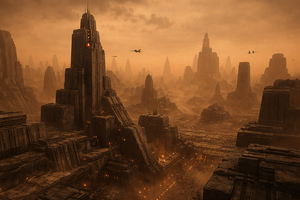 Ellesmeria after the reoccupation by the Eternal Order.
For more than a decade following the crisis, Kapsina remained largely abandoned.
After the return of Faethor Dejarc from the Ethereal Realm in 41 ABY, the ruined world gained renewed strategic importance. Faethor selected Kapsina as the hidden center of power for the emerging Eternal Order, a remnant regime composed of surviving elements of the First Order and the Sith Eternal.
The devastated state of the planet made it an ideal location for concealment. Beneath the ruins of the former Plagueian capital lay hardened infrastructure and subterranean facilities capable of supporting hidden operations.
From these ruins Faethor ruled as Shadow Regent of the Eternal Order while rebuilding his power in the galaxy.
Satellite – Nasva
 Nasva, the moon of Kapsina
A single moon, Nasva, orbits Kapsina. Roughly half the size of the moons orbiting Aerun, it appears to be an irregular fragment of planetary material.
The moon has no atmosphere and cannot support life naturally. Its surface consists of jagged peaks and deep valleys composed of mineral-rich black rock.
Despite the hostile environment, Nasva contains valuable mineral deposits. The satellite was officially declared off-limits by the former Ruling Council. Rumors suggest that abandoned research installations may still exist on its surface.
Planet Geography
Although the destruction of the biosphere dramatically altered the planet’s surface, the outlines of its original continents remain visible from orbit.
Kurast
Located northeast of Khanduras, Kurast consists primarily of sand and clay plains riddled with unstable cave systems. These natural caverns frequently collapse due to seismic activity that continues to affect the region.
Before the planet’s devastation, miners regularly ventured into the region to harvest nearby mineral deposits despite the danger.
Calimcha
The northwestern continent of Calimcha is dominated by rugged mountain ranges and vast dune fields. Lava flows remain common throughout the region, creating extremely hazardous terrain.
Despite the danger, the land contains compounds essential to the production of duracrete, which once made it valuable to industrial operations.
Asinai
The southeastern continent of Asinai features dramatic differences in elevation. Mountain ranges once yielded large alloy deposits, while the western region known as the Barrens became a dumping ground for obsolete mining equipment.
Even before the Horizons Crisis, the Barrens had already become a desolate wasteland.
Schall
Southwest of Khanduras lies Schall, once a rich source of exotic metals. After its resources were depleted the land was sold to the Myrsei civilization.
At the center of the continent stands a lone volcanic mountain whose electromagnetic interference frequently disrupts advanced technology.
Khanduras
Khanduras was once the economic center of Kapsina and the hub of trade between the planet’s continents. Today the landscape is little more than arid plains broken by the remnants of dried seas.
Cities
The former cities of Kapsina have deteriorated into ruins after decades of exposure to violent sandstorms and environmental decay.
Only skeletal remains of their original structures still stand. The most recognizable ruins include the cities of Sapientia, Dicio, Polleo, and Ellesmeria.
Ellesmeria retains the largest number of surviving structures due to the durability of its former military facilities. However, the destruction of the Dark Tower during the withdrawal of Clan Plagueis reduced much of the surrounding district to rubble.
Landmarks
- Land's End – A massive cliff overlooking the remnants of the western sea, riddled with cave systems.
- Dragon Forge – The legendary forge of the Myrsei, said to be haunted by the spirits of ancient smiths.
- Phoenix Falls – A dramatic convergence of lava flows cascading over a mountain ridge.
- Gates of Vlagrand – An ancient defensive pass once used as a military choke point.
- Dragon's Graveyard – A sacred Myrsei site where legendary weapons and artifacts were laid to rest.
- Fallen Moon – The Adegan crystal vein located on Khanduras.
- Howling Mine – A former mining complex where Clan Elder Sarin once conducted alchemical experiments.