
|
Under Construction This page seems to be Under Construction. Watch out for large groups of Rebel fighters.
After construction is complete, please remove this message.
|
The Dark Brotherhood: Customizable Card Game or DB:CCG, is built upon the Star Wars: Customizable Card Game (SW:CCG) that has been converted to the GEMP applicable by the SW:CCG Players Committee.
The DB:CCG is a version of the Star Wars Customizable Card Game (SW:CCG) currently supported by the Brotherhood.
To access the DB:CCG follow this link https://gemp.darkjedibrotherhood.com/.
Origins of Star Wars: Customizable Card Game (SW:CCG)
The original Star Wars: Customizable Card Game (SW:CCG) game was made by Decipher from 1995 to 2001 when Decipher lost the Star Wars license from Lucasfilm. It was, at it's height, the second most popular custom card game (CCG) in the world after Magic: The Gathering (MtG). SW:CCG enabled players to battle between the Light and Dark Sides of the Force. Players created unique decks, typically containing 60 cards, made up of characters, weapons, vehicles, devices, effects, interrupts, and locations throughout Star Wars lore.
The customizable component brought a player's creativity to the forefront. Imagine trying to blow up the Death Star with B-Wings flown by Wookiees or have Han Solo face the Rancor in Jabba's Palace.
Since 2002, the game has been maintained and grown by the Star Wars CCG Players Committee.

SW:CCG Players Committee
The SW:CCG Players Committee is made up on former Decipher employees and passionate volunteers. Under their guidance not only do live events continue throughout the world but SW:CCG made the leap from table top to virtual. Utilizing the GEMP platform SW:CCG could now be played online.
Not stopping there, the SW:CCG Players Committee began publishing unique, virtual, sets to keep SW:CCG alive. The original license for Decipher had expired before the release of Attack of the Clones (AoTC). As such, the SW:CCG Players Committee has created virtual cards for Anakin Skywalker, Jedi Knight, Count Dooku, Ahsoka Tano, and more from the Star Wars franchise that did not exist in 2002. Such as Captain Hera Syndulla and Bo-Katan.
Beyond adding the new content to the game, the SW:CCG Player Committee also has introduced cards that solve for unintended desk designs that are overpowered by introducing new Defense Shield cards or Effects that balance the game play. Since GEMP manages the game rules the SW:CCG Players Committee continually refines the mechanics and rules of the game to improve the player's experience.
All of these cards can be viewed via the Scomp Link maintained by the SW:CCG Players Committee. As of the writing of this article, there have been no less than 27 virtual sets released to GEMP.
Dark Brotherhood: Customizable Card Game Creation
Starting in 2022, Kamjin "Maverick" Lap'lamiz began exploring the public GitHub Repository of the SW:CCG Players Committee. Starting with creating templates for the various SW:CCG cards and running competitions to spark interest in the SW:CCG GEMP based game, Kamjin aspired to having a unique version for the Brotherhood.
By August, 2022 SW:CCG had been added as an officially supported platform for the Brotherhood
By April, 2023, Kamjin had engaged with a developer of the SW:CCG Gemp and began learning the necessary coding skills to understand, replicate, and then create unique cards for the Brotherhood. With the support of then Grandmaster Dacien Victae and Deputy Grandmaster Darth Renatus, Kamjin created a proof of concept. James Entar brought the project over the finish line by hosting it on the Brotherhood's website.
A year after SW:CCG was added as a supported platform, DB:CCG launched in August, 2023.
DB:CCG Expansion Sets
Dark Brotherhood: Core Expansion
The first expansion set focused on confirming that the core cards - characters, vehicles, weapons, devices, sites, systems, interrupts, effects, and objectives could be created.
As such, the theme was kept simple and focused on the members of the Council and the Children of Mortis.
Shadow Academy Expansion
The second expansion sought to validate that net new functionality could be created. In this case, the creation of the Sith Test card which presented the Dark Side with its own version of the Jedi Test cards from the original Dagobah set.
This functionality would later be improved upon with the A Better Tomorrow expansion set.
Great Hutt Expansion

This was the first themed expansion set around a Clan's storyline. Based upon the Clan Scholae Palatinae story involving an expansion of a Hutt gang into the Caperion system. Utilizing competitive and thematic SW:CCG decks as templates, objectives were created that worked in conjunction with each other and helped tell the story, via cards.
A Better Tomorrow Expansion

To offset the large volume of Dark Side cards created with the Great Hutt expansion set, Odan-Urr was selected to be the focus of the fourth set. This set focused on the battle on Quermia and with the Vauzem Dominion.
This set also featured revised graphics for some cards in earlier sets and new functionality, such as enabling non-Force users (e.g., Ability less than 5) cards to be able to serve as mentors for the Sith Test cards.
Understanding the Cards
Before we dive into how to play a game, we'll give you a grounding on the different card types. This information is taken from the SW:CCG Basic Rules. I will also add, the best way to learn the game is by playing with a friend!
Character Cards
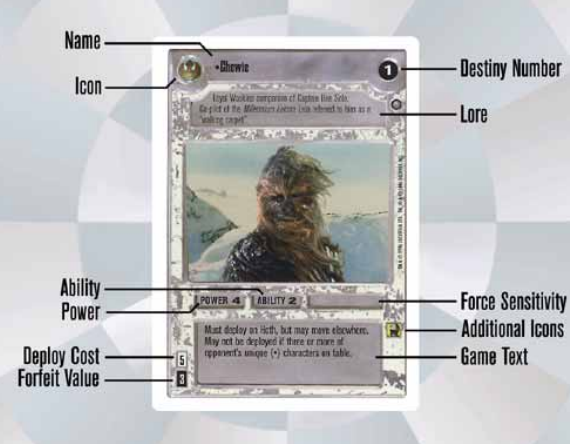
The Character Card is the best to begin with as most of the items on this type of card is translatable to the other cards (e.g., starships, vehicles, etc.).
- Name - This is the unique name of the card. You may see one, two, or three dots next to the name. If a card has a single dot it means it is unique and only one version of that card (or Persona) may be deployed. For example, if you have Chewbacca deployed you cannot also have Chewbacca, Protector or Chewie, Enraged on the table. Deploying a new version would replace the previous one on the table.
- Destiny Number - Think of this as your random number generator (RNG). Drawing destiny will do a variety of things, such as determining if an action is successful, if firing a weapon hits, adding to your power, or unlocking a specific game action.
- Icon - This identifies what 'type' of card it is. In the example of Chewbacca he is a Rebel whereas on Darth Vader the Imperial cog indicates he's an Imperial. There are different icons for vehicles, starships, interrupts, effects, etc. Why this is important on a character card is there are cards that influence certain card types. Such as On The Edge allows you to target a Rebel (e.g., Chewie) or Dark Jedi Presence allows you to target Imperials.
- Additional Icons - There are also smaller icons under the Destiny Number which indicate what set a card was released in. In our example, Chewie was released as part of the Empire Strike Back Introductory Two Player Game set. If we look at Kamjin Lap'lamiz, Proconsul you'll see it was released as part of the Great Hutt Expansion and there is an icon indicate he is a member of Clan Scholae Palatinae. The card Scholae Palatinae's Power would therefore modify Kamjin Lap'lamiz, Proconsul. Below you'll find a grid of common icons.
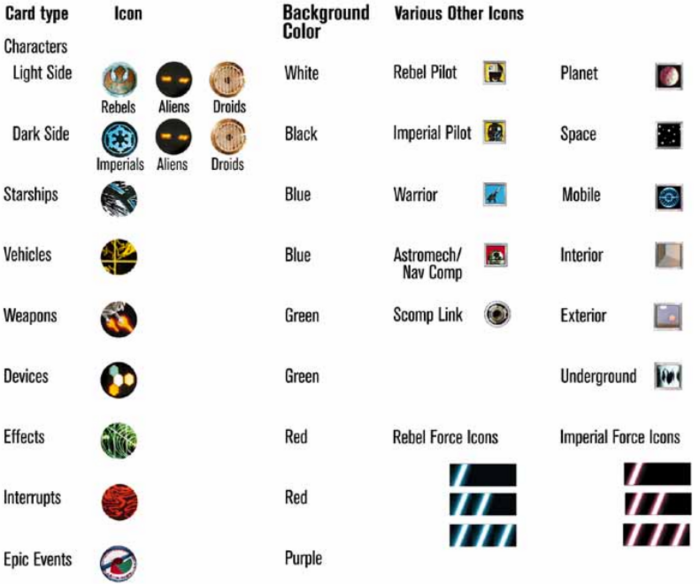
- Additional Icons - Characters - These icons determine if a character may carry a weapon, may pilot a ship, or can be used as an astromech to utilize a starships' hyperdrive.
- Power - This indicates how powerful your character/starship/vehicle is. This impacts whether or not you win a battle with your opponent.
- Ability - Think of this as your defense value. The higher it is, the harder it is to hit. It also indicates your sensitivity to the Force. Character's with ability of 6 or higher are considered Jedi/Dark Jedi and characters with ability of 7 are considered Jedi Master/Dark Jedi Master.
- Deploy Cost - This refers to how much 'Force', or in Magic: The Gathering (MtG) terminology - mana, is needed to deploy the card.
- Forfeit Value - This refers to how much attrition the card can satisfy if you lose it from the table. For example, if you have four attrition to lose after a battle, if you were to lose Chewie he would satisfy three of the four attrition required to be lost. You'd then only need to lose one additional card.
- Game text - This is what makes a card unique. It states what the card is able to do. Such as Han Solo may use one Force to cancel and re-draw your just drawn destiny or Darth Vader adds three to power of anything he pilots.
Location Cards
There are two primary types of locations which function nearly the same. Each site is where you'll deploy your cards with characters and vehicles going to site locations while starships will deploy, typically, to systems.
- Force Icon - indicates how much Force, or in Magic: The Gathering (MtG) language - mana, you may activate per turn. Blue indicates Light Side Force activations while Red indicates Dark Side Force activation.
- Game text - Unlike character/vehicle/starship game text which travels with them, the game text for a site or system is applicable only while you're at that location.
Site
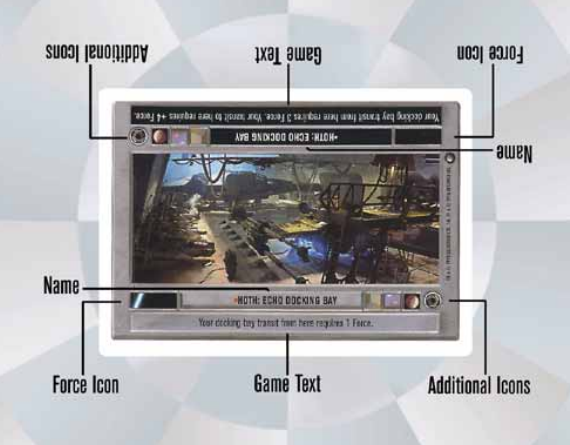
Sites also include additional icons such as:
- Scomplink - This means that certain cards, typically droids, are able to perform a function.
- Type of Site - This indicates if it is an interior, exterior, or mobile site which may impact what types of cards may move there. For example, you can't move an AT-AT to Obi-wan Kenobi's Hut.
System
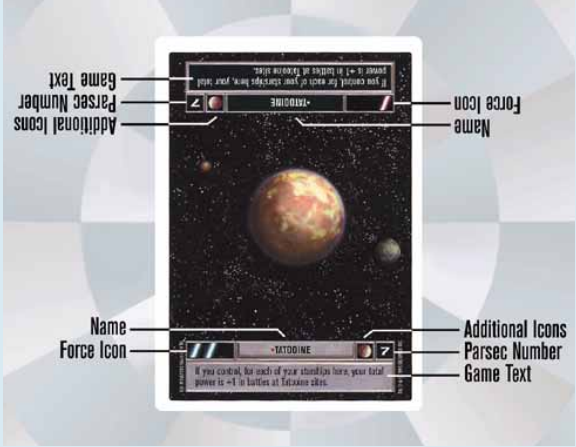
Systems also include a Parsec Number.
- Parsec Number - This indicates where the system is on the 'galactic map'. In terms of gameplay this indicates how many systems you can move based upon a starship's hyperdrive. If you want to move from Tatooine, which has a Parsec of 7, to Coruscant which has a Parsec of 0, you'd need a hyperspeed of 7. Therefore, if your ship has a hyperspeed of 5, to be able to reach there you'd need to have a system with a closer Parsec Number that you could jump to, such as Yavin IV which has a Parsec of 4 (7-4 = hyperspeed of 3 necessary to travel there).
Interrupt Cards
Playing DB:CCG
If you want to skip ahead you can read through a Sample Game drafted by the SW:CCG Players Committee.