The Eternal Order was a covert remnant regime formed in 41 ABY by Faethor Dejarc , known previously as Chi Long, following his return from the Ethereal Realm. Built from surviving elements of the First Order and the Sith Eternal, the organization outwardly claimed to preserve the legacy of Palpatine and the imperial destiny he had forged. In truth, the Eternal Order was the product of Faethor’s ambition. By gathering scattered military remnants, cult loyalists, hidden infrastructure, and abandoned war matériel left in the wake of the First Order’s destruction, Faethor forged a new instrument of power through which he intended to reshape the political balance of the galaxy.
Though its adherents believed themselves guardians of a future Sith restoration, the Eternal Order ultimately served Faethor’s own designs. Its strength, secrecy, and ideology provided him with the means to rebuild his influence, undermine Clan Plagueis, and position himself once again as a decisive power within the Dark Jedi Brotherhood.
The organization ruled from the ruined world of Kapsina in the Deep Core, where Faethor governed under the title of Shadow Regent, presenting himself as the temporary steward of the Emperor’s legacy until the day Palpatine might rise again.
History
Origins
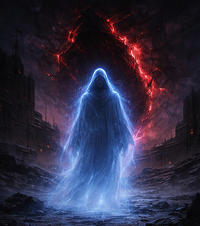 Faethor's Force essence escaping the Ethereal Realm.
The Eternal Order emerged from the wreckage of two defeated but deeply intertwined powers: the First Order and the Sith Eternal. The First Order had arisen from Imperial remnants that fled into the Unknown Regions after the fall of the Galactic Empire, rebuilding their military strength in secret before returning to wage war against the New Republic. The Sith Eternal, operating from the hidden world of Exegol, functioned as an ancient Sith cult devoted to Palpatine, combining dark side devotion with advanced technology, shipbuilding, and clandestine influence throughout the galaxy.
The destruction of these regimes did not erase their legacy entirely. In the aftermath of Exegol, scattered fleets, intelligence networks, supply depots, listening posts, and loyalist enclaves remained hidden across the Outer Rim and the Unknown Regions. These fragments were isolated and leaderless, but they still possessed ships, soldiers, technology, and ideology.
When Faethor returned to the physical galaxy in 41 ABY, he recognized the opportunity these remnants represented. His altered mastery of the Force allowed him to dominate individuals and reconcile factions that would otherwise have destroyed one another through rivalry or mistrust. By invoking the legacy of Palpatine and presenting himself as the custodian of that legacy, Faethor gradually unified surviving elements of both the Sith Eternal and the First Order under a single banner. Many within the emerging Order came to believe that Faethor was a surviving servant of the Emperor’s hidden design, interpreting his return and rise to power as proof that Palpatine’s will continued to shape events even after the fall of Exegol.
To many who joined him, the Eternal Order represented continuity with the past. To Faethor, it was a structure he could control. By allowing his followers to believe they served the Emperor’s future return, he ensured their loyalty while quietly shaping the organization to serve his own ambitions.
Establishment on Kapsina
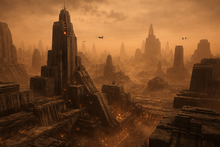 Ellesmeria after the reoccupation by the Eternal Order.
Rather than conceal the Eternal Order in distant Unknown Regions territory, Faethor chose to establish his seat of power on Kapsina, the ruined capital world of Clan Plagueis in the Deep Core.
The planet remained largely devastated. Its biosphere had collapsed across much of the surface, leaving only scattered survivable zones amid a landscape dominated by toxic dust storms and environmental instability. Yet beneath the ruins of the old Plagueian capital city remained hardened infrastructure, subterranean facilities, and strategic defensive advantages.
For Faethor, Kapsina served several purposes at once. Practically, it provided a defensible stronghold from which the Eternal Order could consolidate its resources. Symbolically, it represented a deliberate insult to Clan Plagueis, transforming the fallen heart of the Clan’s former dominance into the seat of power for the conspiracy forming against it.
From the broken cities of Kapsina, Faethor began shaping the Eternal Order into a disciplined remnant state.
Consolidation and Rebirth
The early years of the Eternal Order were devoted to consolidation. Surviving personnel from the First Order provided military organization, fleet doctrine, and intelligence capabilities. Former Sith Eternal adherents contributed clandestine networks, cultic discipline, and knowledge of the arcane technologies and sciences once employed on Exegol.
Through a combination of dark side ritual, Sith Eternal scientific knowledge, and the resources of the growing remnant network, Faethor was able to restore his physical form and reassert himself fully within the galaxy. To his followers, this event became a powerful demonstration that the Eternal Order stood in continuity with the forbidden miracles once associated with the Sith Eternal.
With his position secured, Faethor adopted the title Shadow Regent, claiming to rule only in stewardship of the Emperor’s legacy.
The Shadow Campaign Against Clan Plagueis
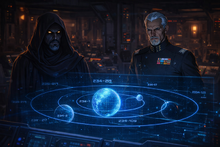 Planning the campaign against Plagueis.
From the beginning, the Eternal Order’s long-term objective extended beyond mere survival. Faethor intended to reassert his influence over Clan Plagueis, and the organization he had built was designed to prepare the conditions necessary to make that possible.
Rather than confront the Clan directly, the Eternal Order began a prolonged campaign of covert manipulation across the Confederacy of the Outer Reaches. Former First Order facilities in the Outer Reaches were quietly reactivated and integrated into the Order’s intelligence network, while hidden listening posts monitored political developments throughout the region.
Agents embedded within commercial and political systems gradually began steering confederate worlds away from reliance on Plagueian leadership. Trade disruptions, rumors, and subtle interference eroded confidence in the stability of Aliso and its governing institutions.
The Crisis on Aliso
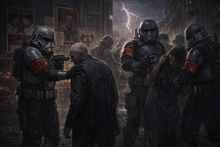 Dread Guard on the streets of Aliso City.
The effects of this hidden campaign became increasingly visible during the unrest that erupted within Aliso City. Internal tensions between the leadership of Clan Plagueis escalated rapidly, with security crackdowns, political division, and open violence spreading across the capital.
The internal conflict ultimately culminated in open fighting within Aliso itself. During the chaos, Selika Roh departed the system aboard the Clan flagship Ascendancy, while control of the Pinnacle passed into the hands of opposing forces.
For the Eternal Order, the outcome represented the successful completion of the first phase of Faethor’s design. The Clan had been weakened, divided, and partially isolated from its allies without the Order ever needing to reveal itself as the architect of the crisis.
Structure
The Eternal Order was, at its core, an act of calculated appropriation. It seized the wreckage of the Sith Eternal and the First Order, preserved their symbols, borrowed their structures, and reanimated their myths, but all in service to Faethor’s ambitions.
To the faithful, the Eternal Order was a bridge to the Emperor’s return. To Faethor, it was a bridge to his own restoration as a galactic power.
Government and Ideology
The Eternal Order’s public ideology was a hybrid of First Order authoritarianism and Sith Eternal restorationism. It preached discipline, secrecy, sacrifice, purity of purpose, and loyalty to the imperial legacy of Palpatine.
Faethor encouraged this belief because it created cohesion among disparate remnants. Yet Faethor himself remained outside that belief, using the Emperor’s memory as a legitimizing myth rather than a genuine article of faith.
Military
The military of the Eternal Order was modeled outwardly on familiar Imperial and First Order structures while absorbing elements of Sith Eternal fanaticism. It retained disciplined naval hierarchy, stormtrooper formations, intelligence networks, and elite internal security units.
Supreme military command rests with an officer bearing the title of Executor. This position is held by Malfkla Yzu, a veteran admiral whose career stretches back to the later years of the Galactic Empire.
Known Assets
While much of the Eternal Order’s strength remains deliberately concealed, several categories of military and strategic assets are known to exist within the organization’s control.
Fleet Forces
The Eternal Order maintains a dispersed naval force composed primarily of surviving vessels from former First Order fleets and remnant Imperial warships preserved in hidden depots following the collapse of the Empire. At the center of this force is a small but powerful squadron of heavy capital ships commanded directly by Executor Malfkla Yzu.
Known capital ships within this force include:
Recusant-class Star Destroyers
- Inevitable Dominion – Flagship of Executor Malfkla Yzu.
- Shadow of Exegol – A modified command destroyer incorporating Sith Eternal communications and sensor technology.
Imperial II-class Star Destroyers
- Unbroken Will – A veteran Imperial warship preserved by remnant naval forces following the fall of the Empire, later integrated into Eternal Order command structures as a fleet anchor vessel.
- Nightfall Ascendant – A strike destroyer configured for rapid-response operations and often deployed as the spearhead of Eternal Order task forces.
- Imperious Fate – A reserve fleet command ship responsible for coordinating dispersed naval groups and protecting the Order’s hidden logistical corridors.
Ground Forces
The Eternal Order fields disciplined stormtrooper formations drawn from surviving First Order units as well as newly trained soldiers indoctrinated into the Order’s ideology.
Intelligence Network
The Eternal Order maintains an extensive intelligence apparatus derived from former First Order surveillance infrastructure and covert Sith Eternal networks.
Strategic Installations
The Order operates from concealed facilities including abandoned First Order bases, hidden shipyards, supply depots, and deep-space listening posts. Its primary seat of power lies on the devastated world of Kapsina, where fortified command centers and subterranean installations have been constructed beneath the ruins of the former Plagueian capital.