
|
| Name: Unknown / Deliberately Erased Alias: Mira Dantavi
|
|
Unknown
|
|
10 ABY (age 34)
|
|
31 ABY (officially)
|
|
Coruscant (officially)
|
|
Overdose (offically)
|
|
Human
|
|
Female
|
|
165cm
|
|
47 Kg
|
|
Chestnut Brown
|
|
Brown
|
|
Alaris Jinn
|
|
Widowmaker
|
|
|
|
Plagueis
|
|
26572
|
Character History
Childhood
The woman who would become known as Mira Dantavi was born on a Mid Rim world to a comfortable, unremarkable family. Her parents were neither wealthy enough to command influence nor poor enough to attract attention, and Mira grew up expecting an ordinary life far removed from galactic politics or conflict.
 A Young Mira rehearsing a classic ballet
Quiet and highly observant from an early age, she had a tendency to notice details others overlooked and possessed an unusual ability to pass unnoticed in social situations. Her principal passion was dance. She trained seriously throughout her teenage years, developing the discipline, physical control, flexibility, and endurance that would later become important to an entirely different profession. Her family included both of her parents and a younger sibling, with whom she was particularly close.
The Fall of Her Family
Mira's life changed after her father, a civil and structural engineer, discovered irregularities connected to a major public infrastructure project. A corporation responsible for the project had been substituting cheaper components and materials for those required under its contracts while continuing to bill the government for the approved specifications. The substitutions were not merely fraudulent. They were unsafe.
Evidence indicated that the corporation was aware of the danger and had suppressed internal findings rather than undertake the expensive process of correcting the problem. Mira's father reported his findings through the appropriate regulatory channels, initially believing the discrepancies would be investigated. Instead, his reports disappeared.
Continued attempts to raise the issue revealed that the corporation's influence extended into the institutions responsible for overseeing it. Officials discouraged further investigation, while representatives of the corporation attempted to convince him that he had misunderstood his findings. When he continued gathering and preserving evidence, the pressure against his family escalated. He was dismissed from his position and accused of professional misconduct. Investigations and financial restrictions followed, while friends and professional associates increasingly distanced themselves from the family.
Eventually, Mira's father was found dead.
Authorities ruled his death a suicide, citing the professional disgrace and criminal investigation surrounding him as evidence of motive. Mira rejected the conclusion. Details surrounding his death contradicted what she knew about her father, but her objections were dismissed by investigators. Her mother eventually came to share her suspicions and began pursuing the matter herself. Shortly thereafter, a transport carrying Mira's mother and younger sibling was destroyed in what authorities determined to be an accident. Mira had been expected to travel with them.
A Survivor
With the remainder of her family dead, Mira was left as the sole surviving member of her immediate family. The official investigation found no evidence of foul play in the transport accident, and the family's insurer subsequently paid Mira a settlement for the deaths of her mother and younger sibling.
The payment served several purposes. To the insurer, the matter was a legitimate claim arising from an unfortunate accident. To those responsible for the deaths, allowing the claim to proceed reinforced the official account while providing the surviving daughter with every incentive to accept the tragedy, collect her inheritance, and move on with her life. There was no reason to create further suspicion by denying a routine claim. Mira accepted the money. She did not accept the explanation.
While examining the circumstances surrounding the transport accident, Mira discovered a discrepancy in its maintenance records. The component identified as responsible for the accident did not correspond with repairs she personally remembered being performed on the vehicle. It was a small inconsistency, easily overlooked by investigators. Mira did not overlook it.
She began examining the deaths of her family and the accusations made against her father, using the settlement and what remained of her family's estate to support herself while she investigated. Slowly, she uncovered evidence that official records had been altered and investigations deliberately compromised. What had initially appeared to be a series of unrelated tragedies increasingly revealed itself as a coordinated effort to silence her father and destroy anyone capable of exposing the original fraud.
Mira attempted to bring what she discovered to the authorities. Nothing happened. She tried again through other channels and received the same result. Eventually, rather than assistance, she received warnings to stop asking questions. The experience permanently altered her understanding of justice. The institutions she had been taught existed to protect ordinary people had not merely failed her family. Some had actively participated in its destruction, while others had chosen not to challenge people with sufficient wealth and influence to protect themselves.
Mira stopped asking the authorities for help.
The Hunter
Mira disappeared from the life she had previously known and devoted herself to identifying everyone responsible for the destruction of her family. She had no formal training in intelligence gathering or covert operations. Instead, she learned through necessity. She followed people, studied routines, entered places where she did not belong, stole information, assumed false identities, and learned how to move through environments without attracting attention.
Skills that had once been incidental parts of her personality became tools. Her patience allowed her to observe targets for long periods without acting prematurely. Her natural anonymity allowed her to disappear into crowds. Years of dance training gave her exceptional physical control and an understanding of movement, posture, and performance that she increasingly incorporated into disguises and infiltration.
Eventually, her investigation identified a small group of individuals directly responsible for what had happened to her family. Mira began hunting them. Her first kill was neither clean nor professional. Despite years spent pursuing the people responsible, the reality of taking a life horrified her. What frightened her more was discovering that she did not regret it.
The remaining deaths became progressively more deliberate. With each target, Mira refined the methods she had taught herself during her investigation. What began as vengeance gradually transformed her into a precise and increasingly capable killer. By the time the last person responsible for her family's destruction was dead, there was little remaining of the dancer who had begun the investigation. But there was also nowhere for her to return.
Assassin
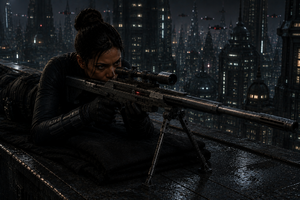 Precision
Mira's activities eventually attracted the attention of criminal organizations that had noticed the unexplained deaths of several well-protected individuals. Offers began arriving through intermediaries for her services. She accepted. What had begun as a personal hunt became a profession. Mira developed a reputation for patience, infiltration, disguise, and precision, preferring careful preparation to unnecessary violence. She discovered that she enjoyed the challenge of her work: learning everything about a target, constructing an approach, entering supposedly secure environments, and completing an objective without error.
She enjoyed killing, but developed little interest in death for its own sake. Unnecessary casualties disgusted her. Killing was the culmination of the work rather than its purpose, and she increasingly judged her own success by how precisely an operation could be completed. For a time, that distinction allowed her to operate comfortably within the criminal underworld. Eventually, she accepted the wrong contract.
The Wrong Target
Mira accepted an assassination contract without investigating the target as thoroughly as she normally would. Only after beginning her preparations did she discover that the justification she had been given was false. Her target was innocent. Rather than complete the contract, Mira refused the assignment.
The decision transformed her from an asset into a liability. The organization that had employed her could not tolerate an assassin who possessed knowledge of its operations and had demonstrated that she might refuse orders according to her own judgment. Mira became the target. It was during the resulting pursuit that her activities intersected with an investigation being conducted by Alaris Jinn, Senator of the Jusadih System. Neither of them yet knew how consequential that meeting would become.
Meeting Alaris
Mira's refusal to complete the contract did not go unnoticed. The organization that had employed her considered both her refusal and her knowledge of its operations unacceptable liabilities, and the assassin soon found herself hunted by many of the same people who had previously employed her. Mira abandoned her established contacts and safe locations, frequently changing her appearance and movements while attempting to determine how extensively the organization had compromised the criminal networks through which she normally operated.
At approximately the same time, Alaris Jinn, then serving as Senator of the Jusadih System in the Republic Senate, had begun investigating the same organization. Its activities extended beyond conventional organized crime and included bribery, intimidation, procurement fraud, blackmail, and targeted killings intended to influence political and commercial affairs within Republic space. Alaris's investigation eventually uncovered evidence of a planned assassination that had progressed unusually far before abruptly stopping. Payment had been arranged, intelligence gathered, and the target's security studied, but the expected killing had never taken place.
Rather than dismiss the failed assassination, Alaris began investigating the assassin responsible for it. He eventually determined that Mira had abandoned the contract voluntarily after discovering that information supplied about the intended target had been deliberately falsified. More significantly to Alaris, she had done so knowing that refusing the assignment would place her own life in danger. Intrigued by the decision, Alaris turned his attention from the abandoned contract to locating the assassin herself.
Despite Mira's attempts to disappear, Alaris found her. Their first meeting was neither an arrest nor an offer of employment. Alaris wanted to understand why a professional assassin who had previously killed for money had suddenly chosen to risk her own life rather than complete a contract. Mira explained that her intended victim was innocent and that the justification for the assassination had been manufactured. When challenged over why she had not established that fact before accepting the contract, Mira did not attempt to excuse the mistake. She admitted that she had failed to investigate the assignment as carefully as she should have and had nearly killed an innocent person because of it.
Her answer interested Alaris more than the refusal itself. Mira had demonstrated both an independent moral judgment and a willingness to accept responsibility when she failed to exercise it. To Alaris, who valued competence but placed considerable importance on an individual's ability to exercise judgment without supervision, the distinction separated Mira from an otherwise capable contract killer.
Alaris revealed that his own investigation concerned the organization hunting her and provided enough information to demonstrate that their interests overlapped. Mira possessed knowledge of its criminal operations and intermediaries that Alaris lacked, while Alaris had access to political, financial, and intelligence resources unavailable to her. Neither trusted the other, but both recognized the usefulness of cooperation. They agreed to work together against the organization as a temporary arrangement, each expecting the relationship to end once their mutual problem had been resolved.
Their initial cooperation was almost entirely practical. Alaris supplied intelligence and objectives while Mira contributed her knowledge of the organization's operations and the skills that had allowed her to survive its attempts to eliminate her. Neither made any attempt to establish a friendship, and both retained information and contingencies against the possibility that the other might eventually become an enemy. Nevertheless, the operation demonstrated to each that the other possessed qualities they rarely encountered. Alaris found Mira disciplined, perceptive, and capable of exercising restraint without requiring his supervision, while Mira discovered that the Republic Senator investigating her former employers was considerably more dangerous and unconventional than his public position suggested.
By the conclusion of their work together, the arrangement had produced something neither had anticipated: respect. Mira had expected Alaris to discard or betray her once she ceased to be useful, while Alaris had initially expected her to disappear once the immediate threat against her had been eliminated. Neither occurred.
Instead, Alaris offered Mira the opportunity to disappear completely.
Dead and Back
In 31 ABY, Alaris offered Mira a permanent solution to the problem of her former employers: she would die.
Her death was staged on Coruscant as a drug overdose. There was little about the apparent death to attract attention, and the resulting investigation confirmed what Alaris intended it to. The authorities identified the body, recorded the death, and closed the case. Anyone from Mira's former life who went looking for her found the same answer.
Alaris went further than simply staging her death. Accounts were closed, government and medical records were altered, and other traces of her former life disappeared. By the time the work was finished, there was little left to connect the living woman to the person who had supposedly died on Coruscant.
With her old identity dead, she chose a new name for herself: Mira Dantavi. Alaris was only one who knew who Mira had been before her death, including the name she had been born with. Whatever records he retained were kept private, and he never again addressed her by her former name.
Mira remained with Alaris afterward. What had begun as a temporary alliance against a common enemy gradually settled into a working relationship. Alaris supplied her with intelligence and objectives but generally left the execution of an assignment to her. He also expected Mira to question an order if she believed something was wrong, the same quality that had drawn his attention to her in the first place.
For her part, Mira found the arrangement preferable to contract work. Alaris had little interest in killing for its own sake and expected her to avoid unnecessary casualties. She was still an assassin, and made no secret of the fact that she enjoyed her work, but the targets Alaris sent her after had a purpose beyond whoever happened to offer the most credits.
Neither of them intended the arrangement to become permanent. It did anyway.
Personality and Philosophy
Mira is quiet and observant, with a habit of noticing details that others miss. She is comfortable with silence and tends to listen more than she speaks, particularly around people she does not know. Around friends she is more relaxed, with a dry sense of humor and a fondness for watching people talk themselves into trouble.
She is fiercely independent and prefers to work alone. Mira does not like being micromanaged and expects to be trusted to determine how best to complete an assignment. She is patient enough to spend days or weeks preparing for a job and has no problem walking away from a plan when something does not feel right.
Mira openly admits that she enjoys killing. She enjoys being good at it even more. Much of the appeal comes from everything surrounding the kill: learning a target's habits, getting into places she should not be, building a convincing disguise, and finding the cleanest way out afterward. She takes pride in completing an assignment without leaving a mess behind.
Unnecessary death disgusts her. Mira will kill without hesitation when she believes it is warranted, but has little tolerance for collateral damage or killing simply because it is convenient. She would rather spend another week planning an operation than kill someone who did not need to die. She also refuses to take someone's guilt on faith. Nearly killing an innocent person once was enough.
Mira does not trust easily and has very few close relationships. Those she does have tend to have been built over years rather than through any particular moment. She rarely talks about how she feels about someone and is much more likely to demonstrate affection by quietly doing something for them.
She still dances. It is one of the few things she carried with her from the life she had before becoming Mira Dantavi, and she keeps it mostly to herself. Years after she began working with Alaris, she discovered a room in one of his residences with mirrors, an open floor, and a ballet barre. She had never told him she was a dancer and had no idea how he knew.
Neither of them ever mentioned it.