
|
| Morvane Palace
|
|
Anzat
|
|
Ezeryth Morvane
|
|
Anzati, Morvane Family
|
History
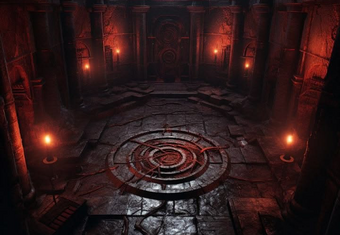 The Sanctum
Origins: The Open Sanctum
Before the palace stood, the site was little more than an open stone sanctum— an ancient structure deliberately left exposed to the sky. Here, the earliest known Anzati gathered to perform ritual sacrifice, feeding upon the life force of their prey in ceremonies both communal and private.
The structure’s open design was intentional. The Anzati believed the unseen currents drifting across the sky were the lingering essence of their ancestors... an omnipresent aura that watched, judged, and perhaps even nourished them in return. To feed beneath the open crimson sky was to commune with that ancestral presence.
Over time, more Anzati were drawn to the site. What began as ritual evolved into an eventual society. Hunting became coordinated, feeding became structured, and the foundation of a collective identity began to take root.
The Rise of House Morvane
With the advancement of technology and the expansion of off world travel with the constructing of floating space ports, the Anzati presence soon spread beyond their homeworld. Many left as diplomats, operatives, and assassins, forming organized networks that funneled wealth, influence, and resources back to their people.
At the center of one such powerful collective rose Ezeryth Morvane, who took the title of their leading Matron. Under her leadership, the once modest sanctum was transformed. Stone gave way to towering architecture, and the structure expanded outward and upward, carved directly into the jagged spires surrounding the site. What had once been a ritual ground became a seat of power, both political and cultural.
Ezeryth Morvane is recorded as the great grandmother of Velira Morvane. Her reign marked the beginning of the palace as a symbol of noble dominance among the Anzati. Her rule came to an end during a planetary conflict that claimed the lives of many Anzati, including the Matron herself. The aftermath ushered in a period of both instability and opportunity.
The Reign of Emperor Vexalis Morvane
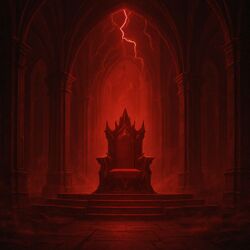 The Morvane Throne
In the aftermath of the war, Emperor Vexalis Morvane, Ezeryth’s successor and Velira’s grandfather, rose to power and led many of the Anzati within this part of their world, into a golden age. Vexalis oversaw a massive reconstruction effort, restoring and expanding the palace into a monumental stronghold of stone and artistry. Beyond its walls, he founded the great city of Vexalis, which would grow to become the largest urban center on the planet. Under his direction, Anzati culture flourished, blending gothic and Sith architectural traditions, with emerging cybernetic and technological advancements.
His rule was defined by expansion and infiltration. Anzati were systematically dispatched across the galaxy as emissaries, spies, and assassins, embedding themselves within foreign powers to manipulate their way into various governing systems. Through this network, wealth and influence poured back into their society, elevating it to unprecedented heights.
Vexalis also redefined internal politics during his rule. Rather than eliminate rival noble houses, he forged alliances through strategic arranged marriages, binding competing bloodlines into a unified aristocracy. This practice became a long standing cultural norm among the Anzati elite. To sustain the growing population, Vexalis established extensive trade agreements with many offworld entities, including dealings within Hutt Space and Nar Shaddaa. These arrangements ensured a steady supply of living prey, though often at significant moral cost.
Decline and the Feral Decree
Despite his accomplishments, Vexalis’s rule eventually succumbed to excess. His prolonged feeding and unchecked indulgence led to mental degradation, and he began to exhibit signs of ferality— a condition feared among the Anzati for its loss of control and reason. Recognizing the threat he posed, his son, Viktor Morvane, made the decisive and controversial choice to execute him. This act not only ended his reign but also established a critical precedent within Anzati society. From that point forward, a formal doctrine was adopted among the nobility: any individual of ruling blood who displayed signs of ferality was to be executed without hesitation, preserving both the stability of leadership and the integrity of the bloodline.
The Succession Crisis and the Rule of Anvara
 Anzati Nobility
Following Vexalis’s death, his only surviving heir, Viktor Morvane, was poised to ascend the throne. However, it was revealed that he was of mixed heritage and not an Anzati pureblood—the son of Vexalis and a female Sephi. This revelation sparked outrage among the Anzati nobility, for whom blood purity was deeply tied to legitimacy. The resulting political crisis nearly escalated into civil war.
A compromise was ultimately reached. Viktor would not take the throne directly. Instead, he would serve as consort and advisor to Anvara Val'Neryx, a pureblooded Anzati noblewoman of significant standing. Upon marriage, she assumed the name Morvane and ascended as ruler.
Anvara’s reign was marked by reform. She sought to regulate feeding practices, ensuring that sustenance was distributed more evenly among the population rather than hoarded by the elite. Additionally, she attempted to establish more controlled and “ethical” sourcing of prey, favoring agreements with off world prison systems over the indiscriminate targeting of civilians. These policies, while stabilizing for the general populace, were deeply unpopular among the nobility.
The Coup of Viktor Morvane
Over centuries, resentment grew. Viktor Morvane, dissatisfied with his subordinate role, began to consolidate power among discontented noble houses. Promising a return to traditional privilege and excess, he gained widespread support from those who opposed Anvara’s reforms. A coup was eventually orchestrated. Anvara was overthrown, imprisoned, and deliberately starved—her execution carried out under the very decree established during Vexalis’s fall. With her death, Viktor claimed the throne for himself.
The Modern Era
 Chiradactyl Palace Guardians
Viktor Morvane has ruled for the past three centuries, maintaining control through a combination of political manipulation, noble alliances, and strict adherence to the structures that preserve his authority. Under his rule, the palace remains both a symbol of Anzati power and a reminder of its bloody history—a place where ritual, nobility, and predation are inextricably intertwined.
Palace Layout
The Morvane Palace is an immense structure carved into the jagged spires of the Anzati homeworld, blending ancient stonework with refined technological enhancements. Its layout reflects both the predatory nature of its inhabitants and the aristocratic culture that defines their rule. Each chamber serves not only a functional purpose, but also reinforces the rituals, hierarchy, and aesthetics of Anzati society.
Lava Moat, Caverns, and Chirodactyls
 Anzati Ferals
Encircling the outer perimeter of the palace lies a vast moat of molten lava, serving as both a natural defense and a stark reminder of the planet’s volatile nature. The flow is carefully channeled through ancient geological formations, creating a near constant barrier that isolates the palace from the surrounding terrain. Beneath and beyond the structure stretches an extensive network of subterranean caverns. These tunnels wind deep into the planet’s crust, eventually opening into massive chambers where exposed magma pools and rivers flow freely. The caverns serve multiple purposes— natural reinforcement, hidden passageways, and, at times, places of exile or disposal. Deep in the caverns, ferals lurk in packs, intentionally placed there to act as deterrents against anyone, Anzati or not, who seek to infiltrate the palace.
Guarding the palace skies are five massive Chirodactyls, bound to the Morvane bloodline and the land itself, trained as living sentinels to guard the palace. These creatures patrol the airspace above the palace and its surrounding spires, their presence alone enough to deter most intruders. Highly territorial and fiercely loyal, they respond aggressively to any unauthorized approach. In addition to these guardians, dense populations of smaller bat like creatures inhabit the spires and cavern entrances. They swarm the skies in near constant motion, particularly during the darker cycles, creating a shifting veil of wings and shadow around the palace.
Ballroom
 Palace Courtyard
The palace ballroom serves as the primary venue for galas, ceremonies, and diplomatic gatherings. Constructed from imported marble and illuminated by a constant low red glow, the space balances elegance with an ever present sense of unease. At its center stands a grand organ, often played during formal events. Along the perimeter, a fully stocked bar caters to guests and nobles alike. Adjacent to the main floor lies a designated feeding gallery. This area features suspended chains and raised platforms, where prey are displayed or restrained as part of elaborate entertainment rituals. Feeding in this space is often performative, reinforcing both status and control among attendees.
Throne Room and Dining Hall
The throne room functions as the political and ceremonial heart of the palace. At its center rises the primary throne, reserved for the reigning Emperor or Empress. The structure itself appears almost unnatural— formed from jagged, shadow like stone that seems to shift subtly depending on the light.
Flanking it are two smaller thrones, traditionally occupied by advisors, consorts, or members of the ruling bloodline. Extending from the throne space is a vast stone dining hall, dominated by a long table etched with centuries of use. Chains are affixed along its surface, stained with the remnants of countless feasts. Here, large-scale communal feedings take place, often coinciding with political gatherings or celebrations. A bar is positioned along the outer wall, ensuring the flow of drink and indulgence remains uninterrupted throughout such events.
The Laboratory
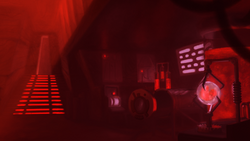 The Lab
Resting within one of the tall palace spires, is the laboratory. This chamber serves as a nexus for both Sith alchemy and Nightsister practices, merging disciplines in pursuit of power and understanding. The walls are lined with carbonite frozen specimens— beings from across the galaxy preserved both for research, as macabre displays of conquest, and as decor. Rumors persist of a sealed vault within the laboratory complex, said to house cultivated strains of disease. These biological agents are believed to be maintained as potential weapons, capable of devastating entire populations if ever unleashed.
Courtyard
At the heart of the palace lies an expansive courtyard, designed to mimic a controlled wilderness. Dark, towering trees form a dense, forest like environment, their canopies filtering light into shifting patterns across the ground below. A small lake rests at its center, still and reflective, framed by the surrounding spires that rise like natural battlements and surrounded by fog. Throughout the space, deep crimson and bioluminescent purple flora thrive, casting an eerie glow during the night cycles. Along the courtyard’s perimeter stands a modest cottage, used to house the palace’s groundskeeper—an often overlooked but essential role in maintaining the delicate balance of the environment.
Bedchambers
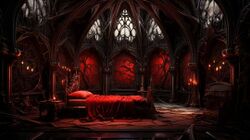 Palace Bedchambers
Reserved for the noble lineage of House Morvane, the palace bedchambers are numerous and appointed according to rank and indulgence. A smaller number are maintained for honored guests, though they rarely rival the decadence afforded to the bloodline itself.
Each noble chamber is accompanied by a lavish washroom of polished stone, fitted with deep soaking basins and intricate fixtures etched with ancestral motifs. Beyond the sleeping quarters, private balconies extend outward from the palace walls, suspended high above the surrounding expanse. From these vantage points, the sky churns endlessly with crimson fog, threaded with the drifting currents of life essence— an ever present reminder of the power that sustains the Morvane name.
Ritual Space
The ritual grounds represent the oldest surviving portion of the palace complex, predating all other structures. Located within the courtyard yet distinctly set apart, this space remains open to the sky, unobstructed by architecture. Encircled by ancient stone formations and crystalline structures, the area is considered the most spiritually significant site on the grounds. It is here that the Anzati believe the flow of ancestral life force is strongest. Ceremonies conducted within this space often mirror the earliest traditions of their species, emphasizing communion with both prey and the unseen presence of their ancestors.
Kitchen and Holding Pens
Beneath the palace lies a sprawling network dedicated to the preparation and storage of sustenance. Referred to collectively as the kitchens, these chambers are designed not for traditional food, but for the handling of living beings intended for consumption. Secured holding pens line the corridors, where captives are contained upon arrival from off world shipments or local acquisition. The area is heavily reinforced, ensuring containment at all times. From these pens, individuals are selected, processed, and delivered to various sections of the palace depending on need.
The Dungeons
Separate from the holding pens, the dungeons extend deeper into the natural cavern systems beneath the palace. Unlike the structured containment areas above, these chambers are raw, uneven, and intentionally oppressive. The dungeons are reserved for prisoners of significance— those accused of treason, political enemies, or individuals deemed worthy of personal interrogation. Torture chambers are embedded within this network, equipped for both physical and psychological extraction of information.
Pleasure Crypt
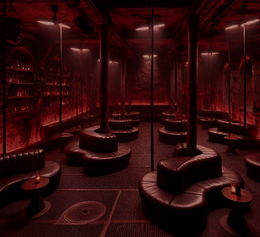 Pleasure Crypt
Located beneath the main level, the Pleasure Cryp is a dimly lit chamber bathed in deep red light, serving as a center of indulgence and vice. Raised platforms host performers, while surrounding tables are used for high stakes gambling. A bar lines one side of the room, acting as a social hub. Toward the rear, private rooms furnished with leather tufted couches offer seclusion for discreet dealings and personal indulgence, away from the watchful eyes of the court.
Hot Springs and Bathing Chambers
Deep within the cavern network beneath the palace lies a series of natural hot springs, where geothermal heat rises from the planet’s core to form steaming pools of mineral rich water. The chambers have been refined with polished stonework and elegant architectural finishes, blending natural formation with deliberate design. Carved walkways and bathing platforms surround the springs, allowing for both communal and private use. The space is adorned with finely crafted marble sculptures, many depicting idealized Anzati nude forms, adding an air of opulence. The bathing chambers serve as a place of restoration and reflection, where nobles and inhabitants alike retreat from the intensity of palace life into the depths below.